Business Vertical Classification Categories: The Complete Guide to Industry, Market, and Business Segmentation

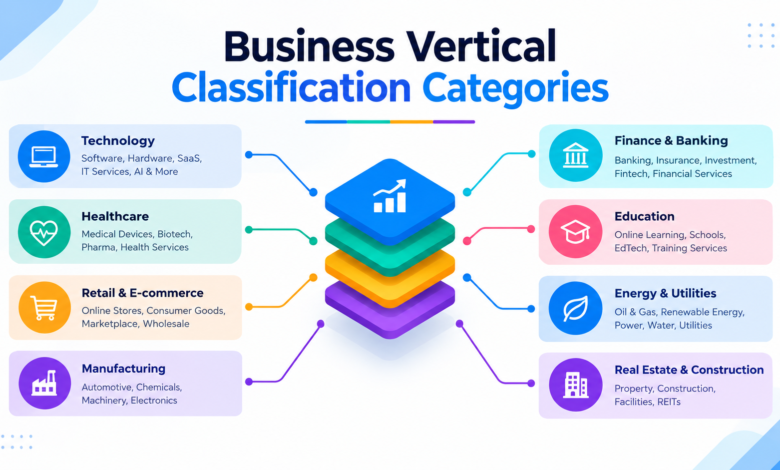
Business Vertical Classification Categories Understanding how companies fit into industries, markets, and specialized commercial segments is essential for modern business strategy. Business Vertical Classification Categories provide a structured way to organize organizations according to what they sell, whom they serve, how they operate, and which market they belong to. For businesses, marketers, analysts, technology platforms, and data teams, accurate classification can make enormous amounts of commercial information easier to understand and act upon.
A useful classification system goes beyond simply labeling a company as “technology,” “retail,” or “healthcare.” A software company serving hospitals has a different commercial profile from a consumer mobile application, even though both may be considered technology businesses. This guide explains how Business Vertical Classification Categories work, why they matter, how verticals differ from industries and niches, and how organizations can create practical classification frameworks for marketing, sales, analytics, market research, databases, and business intelligence.
What Are Business Vertical Classification Categories?
Business Vertical Classification Categories are organized groupings used to classify companies according to their primary commercial activity, target market, customer type, products, services, or operating environment. A vertical typically describes a relatively specific area of business rather than an extremely broad economic sector. For example, “financial services” is broad, while “digital payments,” “commercial banking,” and “insurance technology” represent more specialized commercial verticals.
The purpose of Business Vertical Classification Categories is to create consistency when organizations need to compare, segment, search, analyze, or target businesses. A classification framework can help a marketing platform distinguish between restaurants, healthcare providers, manufacturers, professional services firms, ecommerce stores, and software vendors. When classification rules are clearly defined, different departments can use the same terminology instead of creating conflicting descriptions of the same company.
Why Business Classification Matters in Modern Commerce
Businesses generate enormous amounts of data through websites, customer relationship management systems, advertising platforms, accounting software, marketplaces, social networks, and analytics tools. Without a coherent classification model, that information becomes difficult to segment. Business Vertical Classification Categories turn unstructured commercial information into recognizable groups that can support decisions such as market targeting, product development, lead generation, competitive analysis, and customer segmentation.
Classification also affects how companies understand their position in a market. Consider a company selling appointment-management software to dentists. Its product belongs to software, its customers belong to healthcare, and its specialized market may be dental practice technology. A simplistic category would lose important commercial context. A layered classification system preserves that context by identifying the company, its product category, its customer vertical, and its business model separately.
Business Verticals vs. Industries
The words “industry” and “vertical” are often used interchangeably, but they can represent different levels of classification. An industry usually describes a broad economic activity or group of companies performing similar functions, while a vertical can identify a narrower market or customer segment. Manufacturing is an industry-level concept, whereas automotive manufacturing is a more specific vertical.
Strong Business Vertical Classification Categories recognize that classification can operate at multiple levels. A company may therefore have a parent category such as “Financial Services,” a vertical such as “Insurance,” and a niche such as “Small Business Insurance.” This hierarchy makes data more useful because users can move from broad market analysis to highly specific commercial targeting without changing the underlying classification system.
The Difference Between a Business Sector, Industry, Vertical, and Niche
A business sector is generally the broadest classification level and may include many related industries. An industry groups organizations according to a common economic activity, while a vertical narrows the focus to a particular market, customer segment, or specialized commercial area. A niche is often even narrower and may describe a specific audience, problem, product, or use case within a vertical.
For example, “technology” can be treated as a sector, “software” as an industry category, “cybersecurity software” as a vertical, and “identity management for small financial institutions” as a niche. These layers are not interchangeable. When organizations design Business Vertical Classification Categories, understanding this hierarchy prevents overgeneralization and makes classification more actionable for marketing and analytics teams.
A Core Framework for Business Vertical Classification
A reliable classification framework usually begins with a primary business activity and then adds secondary dimensions. The primary classification should answer a simple question: What does the company primarily do to generate revenue? Secondary fields can identify its customer type, geographic market, business model, product family, regulatory environment, and technology orientation.
A practical implementation of Business Vertical Classification Categories might use a hierarchy such as sector, industry, vertical, sub-vertical, and niche. Additional attributes can then be stored as metadata instead of forcing every characteristic into the same hierarchy. This approach creates a cleaner database and avoids the common mistake of treating business activity, customer segment, company size, and geographic location as if they were all equivalent classification levels.
Major Business Vertical Categories Across the Economy
The global economy contains hundreds of meaningful commercial verticals, but several major categories appear consistently across business directories and market research systems. Common groups include technology, healthcare, financial services, retail, manufacturing, education, real estate, transportation, hospitality, professional services, media, construction, energy, agriculture, telecommunications, and consumer services.
These broad Business Vertical Classification Categories can be subdivided into increasingly specialized markets. Technology may include cloud computing, cybersecurity, artificial intelligence, enterprise software, developer tools, and consumer applications. Healthcare can include hospitals, pharmaceuticals, medical devices, diagnostics, telehealth, dental services, and health technology. The goal is not to create an endless list but to establish useful levels of commercial detail.
Technology and Software Business Verticals
Technology is one of the most diverse classification areas because digital products can serve almost every other industry. Relevant verticals include enterprise software, SaaS, cloud infrastructure, cybersecurity, artificial intelligence, data analytics, fintech platforms, ecommerce technology, customer relationship management, human resources technology, and developer infrastructure.
Within Business Vertical Classification Categories, technology companies should often be classified by both what they provide and whom they serve. A generic project-management application and a project-management platform designed specifically for construction companies may share the same product category but operate in very different commercial markets. Adding a customer-industry dimension allows data systems to capture this distinction without creating unnecessary categories.
Healthcare and Life Sciences Verticals
Healthcare classification is particularly important because it includes providers, manufacturers, researchers, technology companies, insurers, distributors, and specialized professional services. Major areas include hospitals, clinics, dental practices, pharmacies, biotechnology, pharmaceuticals, medical devices, diagnostics, mental wellness services, telemedicine, healthcare software, and laboratory services.
A sophisticated set of Business Vertical Classification Categories should distinguish between healthcare providers and healthcare suppliers. A hospital delivers care directly to patients, while a medical-device manufacturer supplies equipment to providers. A healthcare software company may serve both groups without itself being a clinical provider. These distinctions matter for sales targeting, regulatory analysis, customer research, and competitive intelligence.
Financial Services and Fintech Verticals
Financial services contain traditional institutions as well as rapidly expanding technology-driven markets. Banking, lending, insurance, investment management, accounting, payments, wealth management, financial planning, credit services, and fintech are common classifications. Within each area, additional categories can identify consumer-facing and business-facing services.
Effective Business Vertical Classification Categories in finance should also account for differences in commercial function. A payment processor, mortgage lender, accounting platform, and investment advisory firm may all operate within financial services but solve very different customer problems. Accurate classification therefore supports better prospecting, market sizing, risk analysis, partnership development, and financial technology research.
Retail and Ecommerce Verticals
Retail includes companies that sell products directly to consumers through physical stores, online marketplaces, direct-to-consumer websites, or combinations of channels. Common verticals include grocery, fashion, electronics, home goods, beauty, automotive retail, specialty stores, department stores, and ecommerce.
Within Business Vertical Classification Categories, retail businesses can be further described by product type, distribution model, and customer segment. An online fashion marketplace differs operationally from a local grocery store even though both are retailers. Classification becomes more useful when it records whether the organization is a manufacturer, distributor, marketplace, retailer, or direct-to-consumer brand, rather than relying on a single generic retail label.
Manufacturing and Industrial Verticals
Manufacturing covers organizations that transform raw materials or components into finished products. Important verticals include automotive, aerospace, electronics, machinery, chemicals, food production, textiles, building materials, industrial equipment, packaging, and consumer goods manufacturing.
Industrial Business Vertical Classification Categories frequently need additional operational attributes because manufacturing businesses can differ substantially in their production methods and customers. A business producing semiconductor components has a very different supply chain from a food manufacturer. Similarly, a business selling industrial machinery to other manufacturers has a different commercial model from a consumer appliance brand. These distinctions are valuable for B2B sales and supply-chain analysis.
Professional Services Business Verticals
Professional services businesses primarily sell expertise, specialized knowledge, or advisory capabilities. Examples include legal services, accounting, consulting, architecture, engineering, marketing agencies, public relations, recruitment, management advisory, and business outsourcing.
The usefulness of Business Vertical Classification Categories becomes especially clear in professional services because “services” alone is too broad for most practical purposes. A company searching for legal prospects does not want to receive an undifferentiated list containing advertising agencies and engineering firms. Subcategories allow marketing teams to identify the precise service provider relevant to their campaign, partnership, or research objective.
Real Estate and Property Verticals
Real estate encompasses property development, brokerage, leasing, property management, commercial real estate, residential real estate, real estate investment, construction-related property services, and specialized property technology.
A strong real estate taxonomy can combine business activity with property type. In Business Vertical Classification Categories, a commercial property manager, residential brokerage, industrial developer, and property-management software provider may all relate to real estate while serving different customer groups. Layered classification provides a clearer picture of these relationships and helps companies build highly targeted market segments.
Construction and Infrastructure Verticals
Construction includes residential construction, commercial construction, civil engineering, infrastructure development, specialty contractors, building services, and construction technology. It is a particularly fragmented business environment, with companies ranging from large general contractors to highly specialized local operators.
For Business Vertical Classification Categories, construction classification works best when primary activity and specialty are both recorded. A company may be a commercial general contractor with expertise in healthcare facilities, for example. That profile is more useful than simply labeling it “construction” because it reveals both operational capability and market specialization.
Education and Training Verticals
Education includes schools, universities, vocational institutions, tutoring businesses, online learning platforms, corporate training providers, educational publishers, and education technology companies. The growth of digital learning has made this category increasingly diverse.
Within Business Vertical Classification Categories, education organizations can be segmented by learner type, delivery method, and educational purpose. K–12 education, higher education, professional certification, language learning, corporate training, and test preparation are commercially distinct markets. A taxonomy that captures these distinctions gives education providers and vendors better visibility into potential customers and competitors.
Transportation and Logistics Verticals
Transportation and logistics include trucking, shipping, freight forwarding, warehousing, courier services, public transportation, aviation, maritime transport, supply-chain technology, and last-mile delivery.
The complexity of logistics makes precise Business Vertical Classification Categories particularly valuable. A freight broker, warehouse operator, parcel delivery company, and fleet-management software provider may all participate in the movement of goods while performing completely different roles. Classification should therefore distinguish the company’s function in the supply chain rather than simply labeling everything as transportation.
Hospitality, Travel, and Tourism Verticals
Hospitality includes hotels, resorts, restaurants, accommodation providers, travel agencies, tour operators, event venues, and tourism technology platforms. These businesses may serve consumers directly or support other hospitality organizations.
A detailed set of Business Vertical Classification Categories can distinguish lodging, food service, travel distribution, destination services, and hospitality technology. This matters because customer needs differ dramatically across the ecosystem. A hotel may purchase property-management software, while a restaurant may require point-of-sale technology and a tour operator may need booking and itinerary management tools.
Media, Entertainment, and Creative Verticals
Media and entertainment include publishing, broadcasting, streaming, gaming, music, film, digital media, advertising, creator businesses, and entertainment technology. The boundaries of this category continue to change as traditional media and digital platforms converge.
Modern Business Vertical Classification Categories should be flexible enough to capture emerging business models. A streaming company, independent creator platform, podcast network, traditional publisher, and digital advertising business can overlap in audience and technology while maintaining distinct revenue models. Classification should reflect the company’s primary commercial function rather than simply its use of digital channels.
Energy, Utilities, and Environmental Verticals
Energy and utilities include oil and gas, electricity generation, renewable energy, utilities management, solar, wind, energy storage, environmental services, recycling, waste management, and sustainability technology.
These Business Vertical Classification Categories can become more detailed by distinguishing production, distribution, infrastructure, technology, and services. For example, a solar panel manufacturer and a residential solar installer participate in the same broad renewable-energy ecosystem but occupy different positions in the value chain. Such distinctions are important for procurement, partnerships, market analysis, and investment research.
Agriculture and Food Business Verticals
Agriculture includes farming, agricultural equipment, crop production, livestock, food processing, agricultural technology, distribution, and food services. The sector connects producers, manufacturers, distributors, retailers, and consumers.
Effective Business Vertical Classification Categories can identify where a company sits within the agricultural and food supply chain. An agricultural software company may serve farms, while an equipment manufacturer serves producers and a food distributor serves restaurants or retailers. Classification becomes significantly more useful when these relationships are represented rather than compressed into a single “agriculture” label.
Telecommunications and Connectivity Verticals
Telecommunications includes mobile operators, internet service providers, network infrastructure companies, broadband providers, communications software, satellite communications, and related technology vendors.
Within Business Vertical Classification Categories, telecommunications businesses can be classified according to their role in connectivity. Network operators, infrastructure providers, equipment manufacturers, communication platforms, and enterprise connectivity services represent distinct commercial groups. These distinctions support more precise market intelligence and help companies identify relevant competitors and potential partners.
Consumer Services Verticals
Consumer services include personal care, fitness, home services, repair businesses, automotive services, childcare, pet services, cleaning services, and numerous other customer-facing activities. These businesses often operate locally and depend heavily on geographic demand.
A useful Business Vertical Classification Categories framework can combine service type with customer and location attributes. A plumbing company and a home-cleaning company are both home-service providers but solve different problems. Similarly, a national fitness franchise and a single-location personal training studio may share a vertical while having very different operating models and customer acquisition strategies.
B2B and B2C Classification
One of the most important classification dimensions is whether a business primarily sells to other businesses or directly to consumers. B2B companies often have longer sales cycles, multiple decision-makers, larger contracts, and specialized purchasing requirements, while B2C businesses may prioritize customer volume, convenience, brand awareness, and transactional efficiency.
Business Vertical Classification Categories should therefore be combined with customer-model information whenever possible. A software company selling enterprise cybersecurity systems and another selling consumer antivirus subscriptions may belong to the same broad technology ecosystem but require completely different marketing strategies. B2B and B2C status adds an important commercial layer to the taxonomy.
Business Model as a Classification Dimension
Business model describes how an organization creates and captures value. Common models include subscription, transaction-based, marketplace, advertising-supported, licensing, commission, direct sales, franchise, usage-based, and professional-service models.
Including business model information alongside Business Vertical Classification Categories makes segmentation substantially more powerful. Two businesses can operate in the same vertical but generate revenue differently. A SaaS company may depend on recurring subscriptions, while a marketplace may earn commissions from transactions. Their financial metrics, customer retention strategies, sales processes, and growth priorities can therefore be very different.
Product-Based vs. Customer-Based Classification
There are two common ways to classify a company: by what it sells and by whom it serves. Product-based classification focuses on the offering, while customer-based classification focuses on the target market. Neither method is universally superior.
The strongest Business Vertical Classification Categories systems often use both dimensions. A company may sell accounting software, making “financial software” an appropriate product category, while specifically targeting small law firms, making “legal services” a meaningful customer vertical. Recording both facts gives marketers and analysts a much richer understanding of the company than either classification alone.
Geographic Classification and Business Verticals
Geography is not always a vertical, but it is an important classification attribute. Businesses can be segmented by country, region, state, city, trading bloc, or service territory depending on the purpose of the database.
For Business Vertical Classification Categories, geographic information should generally be stored as a separate field rather than mixed directly into the vertical hierarchy. “Healthcare in Texas” describes both an industry and a location, while “Texas healthcare providers” may be a useful campaign segment. Keeping the dimensions separate allows users to create flexible combinations without multiplying the number of categories unnecessarily.
Company Size and Classification
Company size can be measured through employees, revenue, locations, funding, assets, or another relevant metric. Small businesses, mid-market organizations, enterprises, and multinational corporations often have different needs even when they operate in the same vertical.
A robust Business Vertical Classification Categories framework should therefore avoid treating company size as the primary industry label. Instead, size can become a secondary attribute that enables targeted segmentation. For example, “healthcare technology” identifies the market while “enterprise” identifies the organization size. Together, those attributes produce a much more useful commercial profile.
How to Build a Business Classification Taxonomy
Creating a taxonomy starts with defining the purpose of classification. A sales database may need detailed customer verticals, while a financial research system may prioritize economic sectors and industry codes. Before creating categories, organizations should identify who will use the taxonomy and what decisions it needs to support.
The next step in developing Business Vertical Classification Categories is to establish clear category definitions and hierarchy rules. Each category should have an explicit meaning, inclusion criteria, exclusion criteria, and preferred examples. Organizations should also determine whether companies can have one primary category and multiple secondary categories, because real businesses frequently operate across several markets.
Primary and Secondary Business Categories
Many organizations cannot be accurately described with a single category. A diversified company may sell software, consulting, hardware, and managed services to several industries. Forcing such a business into one label can create misleading data.
A better approach to Business Vertical Classification Categories is to assign one primary classification based on the company’s dominant activity and then permit secondary classifications where justified. The primary category should be determined by a consistent rule, such as the main source of revenue or the company’s core commercial function. Secondary categories can capture meaningful adjacent activities without weakening the primary taxonomy.
Classification by Value Chain Position
A value chain describes how different organizations contribute to the creation and delivery of products or services. Businesses can be producers, manufacturers, distributors, retailers, platforms, service providers, intermediaries, or infrastructure operators.
Using value-chain position alongside Business Vertical Classification Categories provides deeper market intelligence. In automotive markets, for example, original equipment manufacturers, component suppliers, dealerships, financing providers, repair networks, and software companies all participate in the same ecosystem. Their competitive relationships become easier to understand when classification captures their position in that ecosystem.
Classification by Customer Problem
Another useful approach is to classify businesses according to the problem they solve. This is especially valuable in technology and professional services, where companies with very different product names may address similar customer needs.
Business Vertical Classification Categories can be enhanced by problem-oriented tags such as cybersecurity, cost reduction, compliance, customer acquisition, workflow automation, data management, logistics optimization, or employee productivity. Problem-based classification is particularly helpful for solution providers because buyers frequently search for outcomes rather than formal industry terminology.
Classification by Regulatory Environment
Some industries operate under strict regulatory requirements. Healthcare, banking, insurance, pharmaceuticals, aviation, energy, and telecommunications are examples where compliance can materially influence business operations.
Adding regulatory attributes to Business Vertical Classification Categories can help companies identify specialized market requirements. However, regulation should normally be treated as a separate classification dimension rather than defining the entire vertical structure. This allows a database to identify regulated organizations without creating a separate category for every possible legal or compliance environment.
Classification Challenges for Diversified Companies
Large organizations frequently operate in multiple industries, serve multiple customer groups, and generate revenue from different products. A conglomerate may therefore fit into several categories simultaneously. The challenge is deciding which classification should be considered primary.
For Business Vertical Classification Categories, the solution is usually to separate corporate identity from operating activities. The parent organization can have one profile, while subsidiaries, brands, divisions, or business units receive their own classifications. This prevents a complex organization from being inaccurately represented by one broad label.
Classification Challenges for Emerging Businesses
New business models often do not fit established categories. Artificial intelligence companies, creator-economy platforms, decentralized technologies, digital health services, climate technology firms, and other emerging businesses can cross traditional industry boundaries.
A modern Business Vertical Classification Categories framework needs controlled flexibility. Organizations should avoid creating a completely new category every time a new product appears, but they should also avoid forcing emerging businesses into outdated classifications. Temporary tags, emerging-market labels, and periodic taxonomy reviews can provide a practical compromise.
Common Mistakes in Business Classification
One common mistake is creating categories that are too broad. Labels such as “services,” “technology,” or “consumer” may be technically accurate but provide little strategic value. Another mistake is creating categories that are so narrow that users cannot consistently determine where a company belongs.
Another weakness in Business Vertical Classification Categories is inconsistent classification logic. If one company is categorized according to its product and another according to its customers, the resulting database becomes difficult to analyze. A strong taxonomy establishes rules that explain whether categories represent industry, product, customer, business model, value-chain role, or another specific dimension.
A Detailed Comparison of Business Classification Dimensions
| Classification Dimension | What It Describes | Example | Primary Business Use |
|---|---|---|---|
| Sector | Broad economic area | Technology | Market overview |
| Industry | General commercial activity | Software | Industry research |
| Vertical | Specialized market | Cybersecurity | Targeted segmentation |
| Sub-vertical | Narrower market | Identity management | Precise targeting |
| Niche | Highly specific opportunity | Identity tools for small banks | Specialized campaigns |
| Product | What the company sells | SaaS platform | Product research |
| Customer type | Who buys the offering | Enterprise customers | Sales segmentation |
| Business model | How revenue is generated | Subscription | Revenue analysis |
| Value-chain role | Where the company operates | Distributor | Ecosystem mapping |
| Geography | Where it operates | North America | Regional targeting |
| Company size | Organizational scale | Mid-market | Account segmentation |
| Regulatory profile | Compliance environment | Highly regulated | Risk and compliance |
| Technology orientation | Technology dependence | AI-enabled | Technology analysis |
The table illustrates why no single classification field can describe every business accurately. The best Business Vertical Classification Categories systems combine a core vertical taxonomy with separate attributes that answer different commercial questions. This produces a multidimensional business profile while keeping the underlying data organized and searchable.
How Classification Supports Sales and Lead Generation
Sales teams need to identify prospects that resemble their best customers. If a CRM contains only broad industry labels, sales representatives may spend time researching companies that are technically relevant but commercially unsuitable.
Accurate Business Vertical Classification Categories allow sales teams to build targeted account lists based on industry, customer type, company size, location, technology usage, and business model. A cybersecurity provider, for example, can identify mid-sized financial organizations in a particular region rather than contacting every company categorized simply as “technology” or “business services.”
How Classification Supports Digital Marketing
Marketing teams use segmentation to determine which audiences should receive specific messages, offers, advertisements, and content. A broad audience may produce low engagement because the message lacks relevance.
Business Vertical Classification Categories help marketers create industry-specific campaigns. A software provider can develop different content for healthcare organizations, financial institutions, manufacturers, and professional services firms. The product may remain the same, but the language, use cases, pain points, proof points, and conversion arguments can be adapted to each vertical.
How Classification Supports SEO and Content Strategy
Search engines organize information around topics, entities, relationships, and user intent. Businesses that understand vertical classification can create stronger topical content because they can identify the questions, terminology, problems, and use cases associated with a specific market.
Using Business Vertical Classification Categories in an SEO strategy can help publishers build content clusters around industries, business models, customer segments, and related commercial concepts. Instead of publishing disconnected articles, a site can establish comprehensive topical coverage around themes such as SaaS, fintech, healthcare technology, ecommerce, logistics, or professional services.
How Classification Supports Market Research
Market researchers need consistent definitions when estimating market size, identifying competitors, analyzing trends, and comparing organizations. Poor classification can cause companies to be included in the wrong market or excluded from a relevant segment.
Business Vertical Classification Categories create a repeatable structure for market research. Researchers can compare organizations within the same vertical, identify adjacent markets, map competitors, and track how businesses move between categories. This is especially useful when market boundaries are changing because technology allows companies to compete across traditional industry lines.
How Classification Supports Business Intelligence
Business intelligence platforms rely on structured data to produce dashboards, reports, and predictive insights. If company classifications are inconsistent, analytics can produce misleading conclusions.
Well-maintained Business Vertical Classification Categories provide standardized dimensions for reporting. Executives can examine revenue by vertical, customer acquisition by industry, churn by segment, pipeline by business model, or product adoption by company size. Classification transforms raw records into meaningful business patterns that decision-makers can use.
How Classification Supports CRM Data Quality
Customer relationship management systems often contain duplicate, outdated, incomplete, or inconsistent industry information. One salesperson may describe a company as “finance,” another as “banking,” and another as “fintech,” even when they refer to the same organization.
A controlled taxonomy based on Business Vertical Classification Categories reduces this inconsistency. Standardized values can be used in forms, enrichment systems, reporting dashboards, lead-scoring models, and automation workflows. Clear definitions also make it easier to train sales teams and maintain consistent data over time.
How Artificial Intelligence Is Changing Business Classification
Artificial intelligence can classify companies by analyzing websites, product descriptions, business directories, public documents, customer reviews, and other structured or unstructured signals. Instead of relying entirely on manually entered industry fields, organizations can use machine-learning models to infer likely categories.
AI can make Business Vertical Classification Categories more dynamic, but automation should not eliminate governance. A model may misunderstand a company that operates across several industries or confuse its product category with its customer vertical. Human review, confidence scores, classification rules, and audit processes remain important when accuracy has commercial or regulatory consequences.
Automated Classification vs. Manual Classification
Manual classification can be highly accurate when trained specialists review each business, but it becomes expensive and difficult to scale. Automated classification can process large datasets quickly, but it may produce errors when business descriptions are ambiguous or outdated.
For large-scale Business Vertical Classification Categories, a hybrid approach is often strongest. Automation can make an initial classification, while confidence thresholds determine which records require human review. This approach balances speed, consistency, scalability, and quality without pretending that every business can be perfectly classified by a simple algorithm.
How to Measure Classification Quality
Classification quality should be evaluated using measurable criteria rather than subjective impressions. Important indicators include accuracy, consistency, coverage, freshness, duplicate rates, ambiguous-category frequency, and the percentage of records requiring manual correction.
Organizations using Business Vertical Classification Categories can also monitor whether classifications actually improve business outcomes. If segmented marketing campaigns produce stronger engagement or sales teams find more qualified prospects, the taxonomy is creating practical value. A technically elegant taxonomy that does not improve decisions may be unnecessarily complicated.
Taxonomy Governance and Maintenance
Business classifications change over time because companies launch products, enter new markets, merge with other organizations, or change their business models. A taxonomy that is accurate today can become outdated if it is never reviewed.
Governance is therefore essential for Business Vertical Classification Categories. Organizations should establish ownership, review schedules, change-control procedures, category definitions, and rules for handling new industries. A governance team can determine whether a new market deserves its own category or should remain within an existing classification.
Creating a Scalable Category Hierarchy
A scalable hierarchy should balance simplicity with useful detail. Too few categories make segmentation ineffective, while too many categories increase maintenance costs and create confusion.
The most practical Business Vertical Classification Categories often use three to five meaningful levels rather than dozens of nested layers. For example, Technology → Software → Cybersecurity → Identity Management may be sufficient for many applications. Additional information such as company size, geography, customer type, and business model can remain outside the hierarchy as separate fields.
Classification for Small Businesses
Small businesses often have straightforward primary activities but may serve multiple customer groups. A local accounting firm, for example, could specialize in restaurants, startups, and freelancers while still belonging primarily to accounting services.
For small-business datasets, Business Vertical Classification Categories should remain understandable and operationally useful. Excessive complexity can make data entry difficult and create inconsistent records. A concise taxonomy with optional secondary tags is often more effective than an enterprise-grade hierarchy containing thousands of categories.
Classification for Enterprise Organizations
Enterprise companies frequently require more sophisticated classification because they operate across countries, product lines, subsidiaries, and customer segments. Their data environments may include CRM platforms, ERP systems, marketing automation tools, data warehouses, and external business databases.
Enterprise Business Vertical Classification Categories should therefore support interoperability. Definitions need to remain consistent across systems, and mappings may be required between internal taxonomies and external industry standards. Strong governance is particularly important because classification changes can affect reporting, segmentation, account ownership, and strategic planning across large organizations.
Mapping Different Classification Systems
Different databases and platforms often use different industry classifications. One system may organize companies around industries, another around products, and another around customer segments. Mapping these systems requires understanding the semantic relationship between categories rather than simply matching names.
Organizations can create crosswalk tables that connect their Business Vertical Classification Categories to external taxonomies. A crosswalk can specify exact matches, partial matches, broader-parent relationships, and categories requiring manual interpretation. This allows data from multiple sources to be combined without pretending that every classification system has identical definitions.
Industry Codes and Business Taxonomies
Formal industry coding systems are often designed for statistical, governmental, financial, or regulatory purposes. Commercial taxonomies may have different goals, particularly when they are used for marketing, lead generation, or customer segmentation.
Business Vertical Classification Categories can complement formal industry codes rather than replacing them. A company may retain an official industry code for compliance or reporting while using a commercial vertical classification for sales and marketing. Keeping the systems conceptually separate prevents one classification standard from being forced to serve every possible purpose.
Classification and Data Enrichment
Data enrichment adds information to business records from external or internal sources. Industry, employee count, location, technology usage, revenue estimates, and business descriptions are common enrichment attributes.
A well-designed enrichment process can assign Business Vertical Classification Categories using multiple evidence sources. Website content may reveal products, company descriptions may indicate customer segments, and structured databases may provide industry information. Combining signals generally produces a stronger profile than relying on a single field.
Business Classification in Account-Based Marketing
Account-based marketing focuses resources on selected organizations rather than broad audiences. Successful ABM depends on identifying accounts that fit specific strategic criteria.
Business Vertical Classification Categories can help ABM teams define ideal customer profiles. A campaign might target enterprise healthcare providers using cloud infrastructure in selected markets, for example. Vertical classification identifies the industry, while company size, technology, geography, and customer attributes refine the account list.
Classification and Customer Segmentation
Customer segmentation divides a customer base into groups with meaningful similarities. Industry is only one possible segmentation dimension, but it can be extremely powerful in B2B markets.
When Business Vertical Classification Categories are combined with behavioral and firmographic information, companies can discover patterns that broad demographic segmentation misses. A software company may learn that manufacturing customers have different onboarding needs from professional services customers, even when both groups have similar employee counts.
Classification for Competitor Analysis
Competitor analysis requires knowing which organizations actually compete for the same customers or problems. A company may have many firms in its broad industry but only a small number of direct competitors.
Using Business Vertical Classification Categories allows analysts to distinguish direct competitors from adjacent businesses. Product category, customer vertical, business model, geographic market, and value-chain position can be layered together to create a more realistic competitive map. This prevents businesses from treating every organization in a broad industry as an equivalent competitor.
Classification and Business Trends
Business categories evolve as markets mature. New technologies can create new verticals, while older categories may merge or decline. Cloud computing, ecommerce, digital payments, telehealth, artificial intelligence, and renewable energy illustrate how technological change can reshape traditional commercial boundaries.
Regularly updating Business Vertical Classification Categories helps organizations detect these shifts. Classification should not be viewed as a static directory exercise. It is a strategic representation of the market, meaning the framework should evolve when customer behavior, technology, regulation, and business models materially change.
The Role of Semantic Search in Classification
Modern search systems increasingly understand relationships between concepts instead of matching exact keywords. This means classification data can support semantic discovery when categories are clearly defined and connected to related concepts.
A business categorized through Business Vertical Classification Categories can also carry synonyms, related products, customer industries, and use cases. For example, a cybersecurity company may be associated with information security, network protection, identity management, threat detection, and compliance. Semantic relationships make the underlying data more discoverable and useful.
Designing Classification Rules That Humans Can Follow
A classification system is only as reliable as the people and systems using it. If category definitions are vague, different users will interpret them differently. Clear instructions should explain what qualifies for a category and what should be excluded.
For Business Vertical Classification Categories, each important category should ideally have a definition, inclusion criteria, exclusion criteria, representative examples, and escalation guidance. This makes classification more reproducible and reduces disagreements. It also helps automated systems because machine-learning models perform better when training labels are based on consistent human decisions.
Using Real-World Examples to Improve Classification
Examples are powerful because business categories can be abstract. A written definition may say that a vertical covers “organizations providing technology-enabled financial services,” but a real example helps users understand the boundary.
Organizations implementing Business Vertical Classification Categories should maintain examples for common and difficult cases. A payment gateway, online lender, traditional bank, accounting platform, and investment application can demonstrate how neighboring categories differ. Examples should be reviewed periodically so they remain representative of current markets.
A Practical Classification Workflow
A practical workflow begins by identifying the company’s primary revenue-generating activity. Next, the classifier determines the appropriate sector and industry, followed by a vertical and sub-vertical where sufficient evidence exists. Secondary tags can then capture customers, products, business model, geography, and value-chain position.
This workflow makes Business Vertical Classification Categories easier to apply consistently. When evidence is insufficient, the correct response should be to use a broader category or mark the record for review rather than inventing precision. False precision can be more damaging than a carefully chosen broader classification because it creates confidence in inaccurate data.
The Importance of Evidence and Confidence Scores
Classification should ideally be supported by evidence. Useful signals can include official business descriptions, product pages, service pages, regulatory records, structured business databases, and other credible sources.
For automated Business Vertical Classification Categories, confidence scores can indicate how certain a system is about a classification. High-confidence records may pass automatically, while low-confidence records can be routed to human reviewers. This creates a practical quality-control layer and allows organizations to scale classification without treating automated predictions as unquestionable facts.
Future Trends in Business Classification
The future of business classification is likely to become increasingly dynamic, multidimensional, and AI-assisted. Instead of assigning a company one permanent industry label, systems may maintain profiles that reflect products, customers, technologies, business models, geographic markets, and changing strategic focus.
As commercial ecosystems become more interconnected, Business Vertical Classification Categories will increasingly function as relationship maps rather than simple directories. A company may simultaneously belong to a technology vertical, serve healthcare customers, use a subscription model, operate globally, and specialize in compliance automation. Capturing these relationships provides a richer representation of modern commerce.
How Businesses Can Improve Their Classification Strategy
Businesses should begin by identifying the decisions classification needs to support. If the objective is lead generation, customer vertical and company size may matter most. If the objective is financial reporting, industry and organizational structure may be more important. The classification should be designed around actual use cases rather than theoretical completeness.
The next improvement is consistency. Organizations using Business Vertical Classification Categories should document definitions, standardize values, eliminate duplicate labels, establish ownership, and review classifications regularly. A smaller taxonomy that users understand and maintain will generally outperform a huge taxonomy that nobody applies consistently.
A Strategic Example of Classification in Practice
Imagine a company that sells workflow automation software. Its website says it provides cloud-based automation for compliance teams at financial institutions. A simplistic classification might call it “software,” but that does not capture its commercial identity.
A stronger Business Vertical Classification Categories profile could classify the company as Technology → Software → Business Automation → Compliance Automation, with secondary attributes for Financial Services, B2B, SaaS, Enterprise, and North American markets. This richer profile can improve lead generation, content personalization, competitive analysis, and market research without requiring the company to create a completely separate category for every customer use case.
Why Classification Should Not Be Treated as a One-Time Project
Markets change continuously. Companies introduce new services, consumers change purchasing habits, regulations evolve, and technology creates new competitive relationships. A classification system that is never updated gradually loses relevance.
For this reason, Business Vertical Classification Categories should be treated as a living business asset. Organizations should periodically review category performance, identify emerging segments, merge redundant categories, and retire obsolete labels. The objective is not to maintain the largest possible taxonomy; it is to maintain the most useful and accurate representation of the market.
Best Practices for Business Vertical Classification
The strongest classification programs share several characteristics: clear definitions, consistent hierarchy, controlled vocabulary, multiple dimensions, human oversight, automation where appropriate, and regular maintenance. They also distinguish between classification and attributes so that the taxonomy does not become overloaded.
Organizations should keep Business Vertical Classification Categories intuitive enough for everyday users while preserving enough depth for analytics. A well-designed system should make it easy to answer practical questions such as which companies belong to a target market, which customer segments produce the most revenue, which industries have the strongest demand, and where new opportunities are emerging.
Final Takeaway for Business Leaders
Business classification may appear administrative, but it can influence strategic decisions throughout an organization. Accurate categories affect sales targeting, marketing personalization, SEO planning, market research, business intelligence, customer analytics, and competitive strategy.
Business Vertical Classification Categories are most valuable when they reflect how businesses actually operate rather than forcing every organization into a simplistic label. By combining sector, industry, vertical, customer, product, business model, geography, company size, and value-chain information, organizations can create business profiles that are both precise and flexible.
“The goal of classification is not to create more labels; it is to create better decisions.”
That principle captures the central purpose of Business Vertical Classification Categories. A taxonomy should reduce ambiguity, reveal relationships, improve segmentation, and make commercial information easier to use. Whether the system supports a small sales team, a global enterprise, a data platform, or an SEO strategy, classification works best when it is designed around real decisions and maintained as markets evolve.
Frequently Asked Questions About Business Vertical Classification Categories
What are Business Vertical Classification Categories?
Business Vertical Classification Categories are structured groups used to organize companies according to their industries, markets, products, customers, or commercial activities. They help organizations make business data easier to search, compare, segment, and analyze.
Why are Business Vertical Classification Categories important?
Business Vertical Classification Categories improve segmentation, market research, sales targeting, marketing personalization, reporting, and business intelligence. They help organizations distinguish between businesses that may appear similar at a broad industry level but have different products, customers, and operating models.
What is the difference between a business vertical and an industry?
An industry is generally broader and describes a common economic activity, while a vertical typically identifies a more specialized market or customer segment. For example, software can be an industry-level category, while cybersecurity software can represent a more specialized vertical.
Can one company belong to multiple business verticals?
Yes. Many organizations operate across multiple products, customer markets, or industries. Business Vertical Classification Categories can use one primary category alongside carefully defined secondary categories to represent diversified organizations without losing classification consistency.
How are Business Vertical Classification Categories used in marketing?
Marketers use Business Vertical Classification Categories to build targeted audiences, create industry-specific campaigns, personalize messaging, develop relevant content, and identify prospects with similar commercial characteristics. Combining vertical classification with geography and company size can make campaigns even more precise.
How can AI improve business classification?
AI can analyze business descriptions, websites, product information, and other data to suggest classifications at scale. Business Vertical Classification Categories can therefore be assigned more quickly, especially when confidence scoring and human review are used to control classification quality.
Should company size be part of a business vertical?
Company size is usually better treated as a separate attribute rather than as part of the vertical itself. Business Vertical Classification Categories identify what market a company operates in, while employee count, revenue, or enterprise status can describe its organizational scale.
How often should a business taxonomy be updated?
A taxonomy should be reviewed regularly and whenever major market changes occur. Business Vertical Classification Categories can become outdated as new technologies, business models, regulations, and customer markets emerge, so governance and periodic reviews are important.
What makes a good business classification system?
A strong system has clear definitions, consistent rules, logical hierarchy, useful levels of detail, reliable evidence, manageable maintenance requirements, and flexibility for emerging markets. Business Vertical Classification Categories should ultimately make business decisions easier rather than simply creating more administrative data.
Can business vertical classification improve SEO?
Yes. Business Vertical Classification Categories can help content teams identify related topics, customer questions, semantic entities, industry terminology, and content-cluster opportunities. When used naturally, classification concepts can strengthen topical depth and make business content more useful to search audiences.
Conclusion
Business classification is the foundation beneath many modern commercial data systems. It determines how organizations are grouped, compared, discovered, targeted, and analyzed. A carefully designed taxonomy can turn scattered company information into a structured view of the marketplace.
The most effective Business Vertical Classification Categories do not attempt to describe every business using one label. Instead, they create a hierarchy for core commercial activity and add complementary dimensions for customer type, product, business model, geography, company size, technology, and value-chain position. This multidimensional approach reflects the complexity of modern companies while remaining practical for everyday use.
For organizations building databases, CRM systems, market research platforms, SEO strategies, sales programs, or business intelligence dashboards, classification should be treated as a strategic capability. Clear definitions and consistent governance can improve data quality, while automation and AI can make classification scalable. The result is a system that does more than organize companies: it helps organizations understand markets and make better decisions.
When designed thoughtfully, Business Vertical Classification Categories become a shared language across marketing, sales, research, analytics, and leadership teams. They make commercial information easier to interpret, reveal meaningful relationships between businesses, and create a foundation for more precise targeting. In an economy where traditional industry boundaries are constantly changing, that clarity can become a significant competitive advantage.
YOU MAY ALSO READ