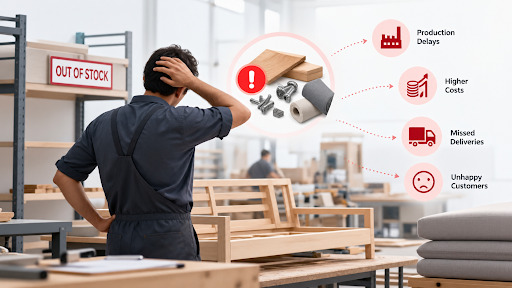
A production order is ready. The machines are available, workers are scheduled, and the customer expects delivery on time. Then the team discovers that one critical material is missing.
It could be a specific board, fitting, fabric, adhesive, or hardware component. Whatever it is, production may have to stop or be rearranged until the material arrives. What looks like a small inventory issue can quickly lead to idle workers, delayed orders, rush purchasing, and higher production costs.
For furniture manufacturers, this is where better visibility becomes important. An ERP for furniture manufacturing can connect inventory, purchasing, production, and order information, helping teams identify material requirements before they become production problems.
But why do these shortages happen in the first place, and what can manufacturers do to prevent them?
A Material Shortage Rarely Stays an Inventory Problem
When a critical material isn’t available, the immediate reaction is usually to place an urgent purchase order and move on. But in a furniture factory, the impact rarely stops there.
If production is waiting for one component, workers may have to switch to another job or remain underutilized. Machines can sit idle, schedules need to be rearranged, and other customer orders may be pushed back. If the missing material has to be sourced quickly, the manufacturer may also pay more for expedited delivery or an alternative supplier.
The financial impact can continue even after the material arrives. A delayed production run can create overtime, rework, additional handling, and wasted materials. When these issues happen repeatedly, they quietly reduce the profitability of otherwise successful orders.
This is why reducing manufacturing waste and unnecessary costs isn’t only about using materials more efficiently. It also means preventing avoidable disruptions before they affect the production floor.
Why Furniture Manufacturers Run Out of Critical Materials
Material shortages rarely happen because a manufacturer simply forgot to order something. In most cases, several small gaps in planning, inventory visibility, or communication come together to create the problem.
1) Inventory Doesn’t Always Mean Availability
A warehouse may show that a material is in stock, but that doesn’t necessarily mean it is available for the next production order. Some quantities may already be reserved for other jobs, damaged, allocated to a different product, or simply insufficient for the actual requirement.
Without a clear view of committed and available inventory, production teams can discover the shortage only when they are ready to use the material.
2) Production Plans Can Change Quickly
Furniture manufacturing often involves custom orders and changing customer requirements. A rush order, design modification, or change in production priority can alter material requirements with little notice.
A material that looked sufficient yesterday may suddenly become a constraint when several orders require the same component.
3) Supplier Delays Add Another Layer of Risk
Even when purchasing teams place orders on time, supplier lead times can change. Delayed shipments, minimum order quantities, quality issues, or unexpected demand at the supplier can all affect when materials actually reach the factory.
If upcoming production depends heavily on those deliveries, even a short delay can disrupt the schedule.
4) Inaccurate Bills of Materials Create Planning Problems
A furniture product can involve dozens of individual components, particularly when designs or configurations vary between orders. If the required quantities are outdated or a component is missing from the product structure, purchasing and production teams may plan around incorrect information.
Maintaining an accurate furniture bill of materials (BOM) helps manufacturers understand exactly what each product requires before production begins. It also gives purchasing teams a clearer basis for planning material requirements instead of discovering missing components at the last minute.
The Domino Effect: What One Missing Component Can Do to a Factory
Imagine a furniture manufacturer has a large order for dining tables. Production is scheduled, the timber and other components are ready, and the team has allocated time on the shop floor.
But one type of hardware needed to complete the tables is short.
At first, it seems like a small purchasing issue. The team places an urgent order and expects production to continue soon. But if the supplier needs several days to deliver, the situation starts affecting everything around it.
The production team may have to move the order down the schedule. Workers can be reassigned, machines may sit unused, and another customer’s order could be brought forward instead. If the missing component arrives later than expected, the original production slot may no longer be available.
The impact can then reach the customer. A delivery date may have to be changed, the manufacturer may need to pay for expedited shipping, or the team may work overtime to recover lost production time.
And there is another problem: the shortage doesn’t always affect just one order. If the same component is required for several products, one missing material can create a backlog across multiple production orders.
That is why material availability needs to be viewed as part of the entire production process, not as a warehouse issue that can be fixed when something runs out.
Why Keeping More Inventory Isn’t Always the Answer
When a manufacturer experiences repeated material shortages, the easiest response is often to order more. Keeping extra stock can provide a buffer, but it isn’t a solution by itself.
Furniture manufacturers deal with a wide range of materials and components. Holding large quantities of everything can tie up significant amounts of cash in inventory that may not be needed immediately. Some materials can also become damaged, outdated, or difficult to use when designs and customer preferences change.
There is also a risk of solving one problem while creating another. Too little inventory can interrupt production, but too much inventory can increase storage costs and working-capital pressure.
The better approach is to know what needs to be available, when it will be needed, and how much is actually required.
That means looking beyond the current stock level. Manufacturers also need to consider upcoming production orders, existing commitments, supplier lead times, expected demand, and material consumption.
The goal isn’t to keep the warehouse full. It’s to maintain enough of the right materials to keep production moving without unnecessarily tying up money in stock.
How Furniture Manufacturers Can Prevent Material Shortages
Preventing material shortages starts before a production order reaches the factory floor. Manufacturers need a clear picture of what they have, what they need, and when they will need it.
1) Keep Product and Material Requirements Accurate
Every furniture product should have an up-to-date list of the materials and components required to produce it. When quantities, specifications, or components change, those details need to be reflected in the production plan.
Even a small discrepancy can result in purchasing too little of a critical component.
2) Set Reorder and Safety Levels Based on Actual Demand
A fixed reorder level may not work for every material. High-volume components may need more buffer stock, while specialized or expensive materials may need tighter purchasing controls.
Manufacturers should consider actual consumption, upcoming orders, supplier lead times, and changes in demand when deciding when to reorder.
3) Connect Purchasing With Production Planning
Purchasing teams need to know what production is scheduled—not simply what inventory is currently low.
If several upcoming orders require the same material, that demand should be visible before purchasing decisions are made. This helps teams avoid both last-minute shortages and unnecessary purchases.
4) Know What Is Available, Reserved, and on the Way
A useful inventory view should answer more than “How much do we have?”
Manufacturers also need to know:
- What is already committed to existing orders?
- What has been ordered from suppliers?
- When are those materials expected?
- Which upcoming production orders depend on them?
- Which materials could become a constraint?
This gives production and purchasing teams an opportunity to act before a shortage reaches the shop floor.
5) Flag Risks Before Production Starts
The most useful warning isn’t the one that appears after production stops. It is the warning that says a material may become unavailable before the planned production date.
With earlier visibility, teams can adjust purchasing, production schedules, or order priorities while there is still time to respond.
From Spreadsheets to Connected Manufacturing Operations
Many furniture manufacturers start with spreadsheets because they are flexible, familiar, and inexpensive. The problem begins when different teams start maintaining different versions of the same information.
Purchasing may have one spreadsheet for incoming materials. The warehouse may track current stock somewhere else. Production may maintain its own schedule, while sales works from customer orders in another system.
Each team may have useful information, but putting it together can take time and sometimes the numbers don’t match.
A connected manufacturing system brings these processes closer together. Sales orders can inform production requirements, production plans can influence purchasing, and inventory information can help teams understand whether materials are actually available for upcoming work.
This kind of visibility is particularly useful when a business is managing multiple products, customized orders, and a large number of components. Instead of waiting for someone to manually check several sources, teams can work from a shared view of inventory, production requirements, and purchasing activity.
For manufacturers considering ERP for furniture manufacturing, the real value isn’t simply having another piece of software. It’s having the key parts of the operation work from connected information so that a material risk can be identified before it becomes a production delay.
What Better Material Visibility Actually Changes
Better material visibility does more than help the warehouse know what is in stock. It gives different teams a clearer picture of what could affect production before those issues become urgent.
For purchasing teams, it means fewer last-minute buying decisions. Instead of reacting when a material reaches zero, they can see upcoming requirements and plan purchases with more time.
For production teams, it means fewer surprises on the shop floor. When the required materials are available before production starts, schedules become easier to follow and workers spend less time waiting or switching between jobs.
Sales and customer service teams also benefit. When production teams have better visibility into material availability, they can give customers more realistic delivery expectations instead of committing to dates that later have to change.
There is also a financial benefit. Fewer emergency purchases, less idle production time, and reduced material waste can help manufacturers protect margins without simply increasing inventory levels.
The real improvement is predictability. When manufacturers know what materials are available, what is already committed, what is coming from suppliers, and what future orders will require, production becomes easier to plan and manage.
The Numbers Furniture Manufacturers Should Watch
A material shortage may look like a one-off incident, but repeated shortages usually leave patterns in the numbers. Tracking the right metrics can help manufacturers identify where material planning is creating problems.
1) Material Shortage Frequency
How often does production face a shortage of a required material?
Practical target: Aim for less than 2–3% of production orders experiencing a material shortage. If the rate consistently exceeds 5%, material planning and inventory visibility likely need attention.
2) Production Downtime Caused by Material Shortages
Track how much scheduled production time is lost because required materials are unavailable.
Practical target: Keep material-related downtime below 1–2% of scheduled production hours. Repeatedly exceeding this level can indicate that shortages are directly affecting production capacity.
3) Emergency Purchases
Frequent urgent purchases are another warning sign. Expedited orders can cost more and usually indicate that materials are being identified too late.
Practical target: Keep emergency purchases below 5% of total material purchases. A lower percentage is preferable for stable, repeat-production environments.
4) Inventory Accuracy
The quantity recorded in the system should closely match what is physically available. Poor inventory accuracy makes it difficult to know whether materials are genuinely available for upcoming production.
Practical target: Maintain 95–98% inventory accuracy for regularly used materials, with critical components ideally reaching 98%+.
5) Supplier Lead-Time Variance
A supplier may normally deliver within a certain timeframe, but actual delivery times can vary.
Practical target: Aim to keep actual supplier lead times within ±10–15% of the expected lead time for reliable suppliers. Larger or repeated variations should trigger a review of supplier performance or safety-stock levels.
6) Production Schedule Adherence
If production frequently moves, pauses, or gets rescheduled because materials are missing, the issue is affecting more than inventory.
Practical target: Aim for 90–95%+ schedule adherence, depending on how much customization and order variability the manufacturer handles.
7) On-Time Order Completion
Ultimately, the customer feels the impact. Tracking whether orders are completed and delivered as planned shows how material availability affects overall business performance.
Practical target: A reasonable goal is 95%+ on-time order completion, with manufacturers serving customers with strict delivery commitments aiming for 98% or higher.
These targets should be treated as starting points, not universal industry standards. The most useful approach is to establish a baseline, track performance consistently, and improve the numbers over time.
The purpose of tracking these metrics isn’t to create more reporting work. It is to identify recurring problems early enough to fix them before they become expensive production disruptions.
The Real Goal is to Prevent the Shortage Before It Happens
Material shortages don’t have to become production emergencies. By tracking critical materials, maintaining accurate BOMs, monitoring supplier lead times, and connecting purchasing with production plans, furniture manufacturers can identify risks before they disrupt the factory floor.
An Odoo ERP manufacturing solution can bring these processes together, giving teams better visibility into inventory, material requirements, purchasing, and production.
The goal isn’t to keep more inventory. It is to have the right materials available at the right time, so production stays on schedule, costs remain controlled, and customer commitments are easier to meet.