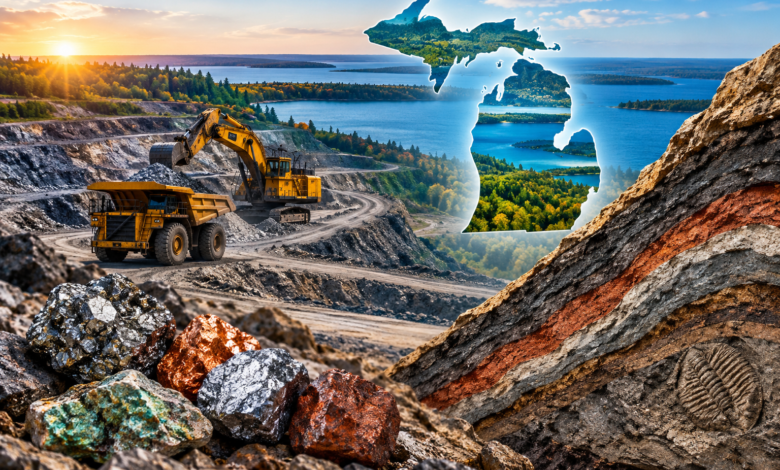
Michigan’s landscape contains evidence of geological processes that occurred over immense periods of time. Beneath forests, lakes, and rocky terrain lie formations that reveal how mineral resources developed. Mining in Michigan is closely connected to this geological history, particularly in the Upper Peninsula, where copper-bearing formations have attracted scientific and industrial interest for generations.
A Landscape Shaped by Ancient Geological Forces
Michigan’s mineral resources developed through complex geological activity, including volcanic processes, sediment accumulation, and changes in the Earth’s crust.
The Lake Superior region is particularly notable for its ancient rock formations.
These formations provide valuable evidence about the geological conditions that influenced mineral concentration.
The Role of Ancient Volcanic Activity
Volcanic activity helped shape portions of the Lake Superior basin more than a billion years ago.
As geological conditions changed, mineral-bearing fluids moved through certain rock formations, contributing to the development of copper deposits.
Understanding these processes remains important for interpreting the region’s mineral potential.
How Michigan’s Mining History Developed
Mining in Michigan has a long history that includes Indigenous copper use and later large-scale industrial extraction.
Native communities worked native copper long before European settlement, producing objects for practical, ceremonial, and exchange purposes.
During the nineteenth century, industrial mining expanded significantly in parts of the Upper Peninsula.
The Historical Copper Districts
The Keweenaw Peninsula became widely associated with copper extraction because of its distinctive geological deposits.
Mining settlements developed around mineral discoveries, bringing changes to transportation, employment, and regional infrastructure.
Although historical operations eventually declined, their physical and cultural legacy remains visible.
Understanding Mineral Deposits in Michigan
Not all mineral deposits occur in the same geological setting.
Some copper resources are associated with native copper formations, while others occur within sedimentary rocks containing copper-bearing minerals.
These differences influence exploration methods and potential extraction approaches.
Why Geological Mapping Matters
Geological mapping helps researchers identify rock types, structural features, and areas where mineralization may occur.
Exploration teams combine mapping with sampling and subsurface investigations to develop a clearer understanding of potential deposits.
For mining in Michigan, geological knowledge is essential because mineral formations can vary considerably across relatively short distances.
The Relationship Between Mining and Regional Communities
Mineral development has influenced settlement patterns, employment opportunities, and infrastructure throughout parts of Michigan.
Historical mining communities often developed around transportation corridors and access to natural resources.
Today, discussions about potential mineral development include economic opportunities alongside environmental and community considerations.
Preserving Historical Knowledge
Mining heritage provides opportunities to study industrial history, engineering practices, and regional culture.
Preserved structures, historical records, and archaeological evidence help explain how earlier generations approached mineral extraction.
This knowledge also illustrates how expectations surrounding worker safety and environmental management have changed.
Environmental Considerations in Michigan
Michigan’s extensive freshwater resources make environmental planning particularly significant.
Mining proposals may require detailed evaluation of water quality, surface drainage, wildlife habitats, and surrounding ecosystems.
The region’s seasonal weather conditions also influence operational planning.
Protecting Sensitive Natural Resources
Environmental assessments help identify potential pathways through which mining activities could affect nearby resources.
Monitoring programs, engineered controls, and reclamation planning can contribute to impact management.
Their effectiveness depends on site conditions, implementation, and ongoing oversight.
Looking Toward the Future
Mining in Michigan continues to attract attention because of the state’s geological resources and industrial heritage.
Future development decisions require balancing geological knowledge, technical feasibility, environmental protection, and community perspectives.
Scientific research remains essential for understanding both opportunities and limitations.
Conclusion
Mining in Michigan represents an important connection between ancient geology and regional history. The state’s copper-bearing formations reveal remarkable geological processes, while its mining heritage reflects generations of industrial change.
A deeper understanding of this history provides useful context for evaluating modern mineral exploration, environmental responsibilities, and the future of resource development in Michigan.

