Business Vertical Classification: A Complete Guide to Industry, Market, and Business Segmentation


Business Vertical Classification Categories Understanding how companies fit into industries, markets, and specialized commercial segments is essential for modern business strategy. Business Vertical Classification Categories provide a structured way to organize organizations according to what they sell, whom they serve, how they operate, and which market they belong to. For businesses, marketers, analysts, technology platforms, and data teams, accurate classification can make enormous amounts of commercial information easier to understand and act upon.
What Are Business Vertical Classification Categories?
Business Vertical Classification Categories are organized groupings used to classify companies according to their primary commercial activity, target market, customer type, products, services, or operating environment. A vertical typically describes a relatively specific area of business rather than an extremely broad economic sector. For example, “financial services” is broad, while “digital payments,” “commercial banking,” and “insurance technology” represent more specialized commercial verticals.
Why Business Classification Matters in Modern Commerce
Businesses generate enormous amounts of data through websites, customer relationship management systems, advertising platforms, accounting software, marketplaces, social networks, and analytics tools. Without a coherent classification model, that information becomes difficult to segment. Business Vertical Classification Categories turn unstructured commercial information into recognizable groups that can support decisions such as market targeting, product development, lead generation, competitive analysis, and customer segmentation.
The Difference Between a Business Sector, Industry, Vertical, and Niche
A business sector is generally the broadest classification level and may include many related industries. An industry groups organizations according to a common economic activity, while a vertical narrows the focus to a particular market, customer segment, or specialized commercial area. A niche is often even narrower and may describe a specific audience, problem, product, or use case within a vertical.
A Core Framework for Business Vertical Classification
A reliable classification framework usually begins with a primary business activity and then adds secondary dimensions. The primary classification should answer a simple question: What does the company primarily do to generate revenue? Secondary fields can identify its customer type, geographic market, business model, product family, regulatory environment, and technology orientation.
Major Business Vertical Categories Across the Economy
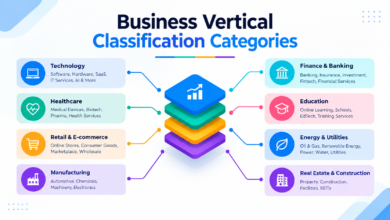
The global economy contains hundreds of meaningful commercial verticals, but several major categories appear consistently across business directories and market research systems. Common groups include technology, healthcare, financial services, retail, manufacturing, education, real estate, transportation, hospitality, professional services, media, construction, energy, agriculture, telecommunications, and consumer services.
Technology and Software Business Verticals
Technology is one of the most diverse classification areas because digital products can serve almost every other industry. Relevant verticals include enterprise software, SaaS, cloud infrastructure, cybersecurity, artificial intelligence, data analytics, fintech platforms, ecommerce technology, customer relationship management, human resources technology, and developer infrastructure.
Healthcare and Life Sciences Verticals
Healthcare classification is particularly important because it includes providers, manufacturers, researchers, technology companies, insurers, distributors, and specialized professional services. Major areas include hospitals, clinics, dental practices, pharmacies, biotechnology, pharmaceuticals, medical devices, diagnostics, mental wellness services, telemedicine, healthcare software, and laboratory services.
Financial Services and Fintech Verticals
Financial services contain traditional institutions as well as rapidly expanding technology-driven markets. Banking, lending, insurance, investment management, accounting, payments, wealth management, financial planning, credit services, and fintech are common classifications. Within each area, additional categories can identify consumer-facing and business-facing services.
Retail and Ecommerce Verticals
Retail includes companies that sell products directly to consumers through physical stores, online marketplaces, direct-to-consumer websites, or combinations of channels. Common verticals include grocery, fashion, electronics, home goods, beauty, automotive retail, specialty stores, department stores, and ecommerce.
Manufacturing and Industrial Verticals
Manufacturing covers organizations that transform raw materials or components into finished products. Important verticals include automotive, aerospace, diploma framing, electronics, machinery, chemicals, food production, textiles, building materials, industrial equipment, packaging, and consumer goods manufacturing.
Professional Services Business Verticals
Professional services businesses primarily sell expertise, specialized knowledge, or advisory capabilities. Examples include legal services, accounting, consulting, architecture, engineering, marketing agencies, public relations, recruitment, management advisory, and business outsourcing.
Real Estate and Property Verticals
Real estate encompasses property development, brokerage, leasing, property management, commercial real estate, residential real estate, real estate investment, construction-related property services, and specialized property technology.
Education and Training Verticals
Education includes schools, universities, vocational institutions, tutoring businesses, online learning platforms, corporate training providers, educational publishers, and education technology companies. The growth of digital learning has made this category increasingly diverse.
Hospitality, Travel, and Tourism Verticals
Hospitality includes hotels, resorts, restaurants, accommodation providers, travel agencies, tour operators, event venues, and tourism technology platforms. These businesses may serve consumers directly or support other hospitality organizations.
Media, Entertainment, and Creative Verticals
Media and entertainment include publishing, broadcasting, streaming, gaming, music, film, digital media, advertising, creator businesses, and entertainment technology. The boundaries of this category continue to change as traditional media and digital platforms converge.
Telecommunications and Connectivity Verticals
Telecommunications includes mobile operators, internet service providers, network infrastructure companies, broadband providers, communications software, satellite communications, and related technology vendors.
Consumer Services Verticals
Consumer services include personal care, fitness, home services, repair businesses, automotive services, childcare, pet services, cleaning services, and numerous other customer-facing activities. These businesses often operate locally and depend heavily on geographic demand.
B2B and B2C Classification
One of the most important classification dimensions is whether a business primarily sells to other businesses or directly to consumers. B2B companies often have longer sales cycles, multiple decision-makers, larger contracts, and specialized purchasing requirements, while B2C businesses may prioritize customer volume, convenience, brand awareness, and transactional efficiency.
Business Model as a Classification Dimension
A business model describes how an organization creates and captures value. Common models include subscription, transaction-based, marketplace, advertising-supported, licensing, commission, direct sales, franchise, usage-based, and professional-service models.
Geographic Classification and Business Verticals
Geography is not always a vertical, but it is an important classification attribute. Businesses can be segmented by country, region, state, city, trading bloc, or service territory depending on the purpose of the database.
Company Size and Classification
Company size can be measured through employees, revenue, locations, funding, assets, or another relevant metric. Small businesses, mid-market organizations, enterprises, and multinational corporations often have different needs even when they operate in the same vertical.
How to Build a Business Classification Taxonomy
Creating a taxonomy starts with defining the purpose of classification. A sales database may need detailed customer verticals, while a financial research system may prioritize economic sectors and industry codes. Before creating categories, organizations should identify who will use the taxonomy and what decisions it needs to support.
Primary and Secondary Business Categories
Many organizations cannot be accurately described with a single category. A diversified company may sell software, consulting, hardware, and managed services to several industries. Forcing such a business into one label can create misleading data.
Classification by Value Chain Position
A value chain describes how different organizations contribute to the creation and delivery of products or services. Businesses can be producers, manufacturers, distributors, retailers, platforms, service providers, intermediaries, or infrastructure operators.
Classification by Customer Problem
Another useful approach is to classify businesses according to the problem they solve. This is especially valuable in technology and professional services, where companies with very different product names may address similar customer needs.
Classification by Regulatory Environment
Some industries operate under strict regulatory requirements. Healthcare, banking, insurance, pharmaceuticals, aviation, energy, and telecommunications are examples where compliance can materially influence business operations.
Classification Challenges for Diversified Companies
Large organizations frequently operate in multiple industries, serve multiple customer groups, and generate revenue from different products. A conglomerate may therefore fit into several categories simultaneously. The challenge is deciding which classification should be considered primary.
Classification Challenges for Emerging Businesses
New business models often do not fit established categories. Artificial intelligence companies, creator-economy platforms, decentralized technologies, digital health services, climate technology firms, and other emerging businesses can cross traditional industry boundaries.
How Classification Supports Digital Marketing
Marketing teams use segmentation to determine which audiences should receive specific messages, offers, advertisements, and content. A broad audience may produce low engagement because the message lacks relevance.
How Classification Supports SEO and Content Strategy
Search engines organize information around topics, entities, relationships, and user intent. Businesses that understand vertical classification can create stronger topical content because they can identify the questions, terminology, problems, and use cases associated with a specific market.
How Classification Supports Market Research
Market researchers need consistent definitions when estimating market size, identifying competitors, analyzing trends, and comparing organizations. Poor classification can cause companies to be included in the wrong market or excluded from a relevant segment.
How Classification Supports Business Intelligence
Business intelligence platforms rely on structured data to produce dashboards, reports, and predictive insights. If company classifications are inconsistent, analytics can produce misleading conclusions.
How Classification Supports CRM Data Quality
Customer relationship management systems often contain duplicate, outdated, incomplete, or inconsistent industry information. One salesperson may describe a company as “finance,” another as “banking,” and another as “fintech,” even when they refer to the same organization.
How Artificial Intelligence Is Changing Business Classification
Artificial intelligence can classify companies by analyzing websites, product descriptions, business directories, public documents, customer reviews, and other structured or unstructured signals. Instead of relying entirely on manually entered industry fields, organizations can use machine-learning models to infer likely categories.
Automated Classification vs. Manual Classification
Manual classification can be highly accurate when trained specialists review each business, but it becomes expensive and difficult to scale. Automated classification can process large datasets quickly, but it may produce errors when business descriptions are ambiguous or outdated.
How to Measure Classification Quality
Classification quality should be evaluated using measurable criteria rather than subjective impressions. Important indicators include accuracy, consistency, coverage, freshness, duplicate rates, ambiguous-category frequency, and the percentage of records requiring manual correction.
Taxonomy Governance and Maintenance
Business classifications change over time because companies launch products, enter new markets, merge with other organizations, or change their business models. A taxonomy that is accurate today can become outdated if it is never reviewed.
Creating a Scalable Category Hierarchy
A scalable hierarchy should balance simplicity with useful detail. Too few categories make segmentation ineffective, while too many categories increase maintenance costs and create confusion.
Classification for Small Businesses
Small businesses often have straightforward primary activities but may serve multiple customer groups. A local accounting firm, for example, could specialize in restaurants, startups, and freelancers while still belonging primarily to accounting services.
Classification for Enterprise Organizations
Enterprise companies frequently require more sophisticated classification because they operate across countries, product lines, subsidiaries, and customer segments. Their data environments may include CRM platforms, ERP systems, marketing automation tools, data warehouses, and external business databases.
Mapping Different Classification Systems
Different databases and platforms often use different industry classifications. One system may organize companies around industries, another around products, and another around customer segments. Mapping these systems requires understanding the semantic relationship between categories rather than simply matching names.
Industry Codes and Business Taxonomies
Formal industry coding systems are often designed for statistical, governmental, financial, or regulatory purposes. Commercial taxonomies may have different goals, particularly when they are used for marketing, lead generation, or customer segmentation.
Final Takeaway for Business Leaders
Business classification may appear administrative, but it can influence strategic decisions throughout an organization. Accurate categories affect sales targeting, marketing personalization, SEO planning, market research, business intelligence, customer analytics, and competitive strategy.