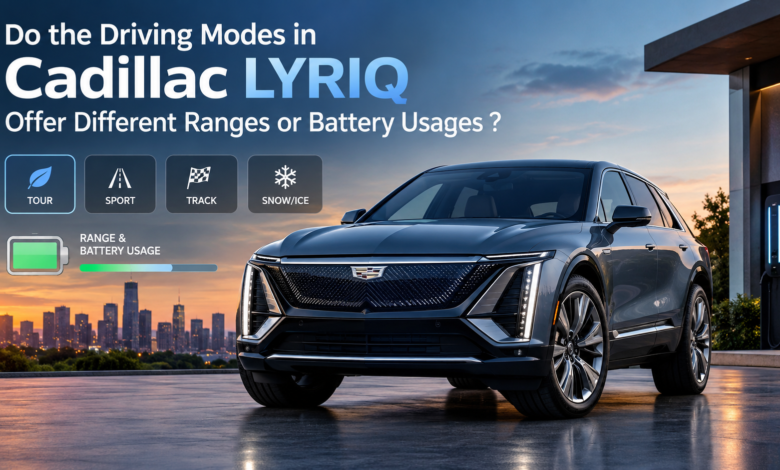
If you are considering a Cadillac LYRIQ, one practical question often comes up after the excitement of its electric performance: do the driving modes in Cadillac LYRIQ offer different ranges or battery usages? The short answer is that the modes do not create separate battery capacities or fixed range ratings, but they can influence how efficiently the vehicle uses energy in real-world driving.
Cadillac offers modes such as Tour, Sport, Snow/Ice, and My Mode on the LYRIQ, depending on model year and equipment. These settings change accelerator response, vehicle behavior, steering feel, braking characteristics, or traction management rather than changing the physical size of the battery.
The important distinction is between a drive mode’s calibration and actual energy consumption. A mode can encourage smoother acceleration or make power delivery more immediate, while your speed, temperature, road conditions, HVAC use, tires, elevation, traffic, and driving style can have a much larger effect on the number of miles you ultimately get from a charge.
What the Driving Modes Actually Change in a Cadillac LYRIQ
The first thing to understand is that do the driving modes in Cadillac LYRIQ offer different ranges or battery usages is really a question about efficiency rather than battery capacity. Selecting Tour instead of Sport does not install a different battery, increase the usable kilowatt-hours, or permanently change the vehicle’s EPA-rated range. Instead, the software modifies how the vehicle responds to the driver’s inputs.
Cadillac describes Tour as the predominant everyday setting, Snow/Ice as a mode intended to help prevent wheel spin on slippery roads, Sport as a setting with more immediate torque response and enhanced road connection, and My Mode as a customizable driving configuration.
Does Tour Mode Give the LYRIQ Better Range?
Tour is generally the logical choice when efficiency and predictable everyday driving are the priorities. Cadillac describes Tour as being calibrated for a smooth ride and everyday use, which can make it easier to drive progressively rather than constantly requesting strong acceleration. That behavior can contribute to efficient energy consumption.
However, it would be inaccurate to say that Tour mode automatically guarantees a particular number of extra miles. If a driver uses Tour aggressively, travels at high highway speeds, drives into strong wind, or runs the climate system heavily, consumption can still rise. Therefore, do the driving modes in Cadillac LYRIQ offer different ranges or battery usages should be answered in terms of tendencies rather than guaranteed mode-specific range figures.
Does Sport Mode Use More Battery Energy?
Sport mode is designed around a more responsive driving experience. Cadillac says it provides more immediate torque response and improved steering characteristics at higher speeds, making the LYRIQ feel more connected and energetic. That calibration can make rapid acceleration easier and more tempting.
The mode itself should not be treated as a switch that suddenly drains a fixed percentage of the battery. Instead, the driver’s behavior matters. If Sport causes you to accelerate harder and more frequently, energy consumption can increase. This is one of the clearest reasons the answer to do the driving modes in Cadillac LYRIQ offer different ranges or battery usages is nuanced rather than simply yes or no.
How Snow/Ice Mode Affects Energy Consumption
Snow/Ice mode has a different purpose from Sport. It is intended to help control wheel spin on slippery surfaces, and Cadillac specifically describes it as a mode designed for snow or other slippery driving conditions. Its pedal and torque response are tuned to make acceleration more controlled.
That means Snow/Ice should not be selected simply because you want maximum range. If the road is dry, Tour may be the more natural everyday setting. On an icy road, however, the priority should be controlled traction and safe vehicle behavior rather than squeezing the last possible mile from the battery. This distinction is essential when considering do the driving modes in Cadillac LYRIQ offer different ranges or battery usages.
What Is My Mode on the Cadillac LYRIQ?
My Mode gives drivers a way to personalize aspects of the LYRIQ’s driving experience. Cadillac says the setting can allow adjustments involving accelerator responsiveness, steering feel, braking responsiveness, and Electric Vehicle Sound Enhancement, depending on configuration.
Because My Mode can be configured, its energy impact depends heavily on the settings selected and how the driver responds to them. A conservative configuration can feel relaxed, while a more responsive configuration can encourage quicker inputs. Consequently, do the driving modes in Cadillac LYRIQ offer different ranges or battery usages cannot be answered by assigning one universal efficiency number to My Mode.
Does a Driving Mode Change the LYRIQ’s Battery Capacity?
No. A driving mode does not physically change the battery pack’s capacity. The LYRIQ uses GM’s Ultium battery architecture, and the battery’s physical energy-storage capability does not expand or shrink when the driver changes from Tour to Sport.
What can change is the rate at which stored electrical energy is consumed. Think of the battery as a fuel tank and the driving mode as part of the vehicle’s control strategy. Changing the strategy can influence how the available energy is delivered, but it does not create additional stored energy. That is why do the driving modes in Cadillac LYRIQ offer different ranges or battery usages is primarily an efficiency question.
Range Versus Battery Usage: What Is the Difference?
Range is the distance the LYRIQ can travel before the available battery energy is depleted to the point that charging becomes necessary. Battery usage is the amount of electrical energy consumed over a given distance or period. These concepts are related, but they are not identical.
For example, two drivers can start with the same battery percentage and travel the same distance but finish with different percentages because their speeds, acceleration patterns, temperatures, routes, and climate settings were different. This is why do the driving modes in Cadillac LYRIQ offer different ranges or battery usages needs to be considered alongside the conditions surrounding each drive.
Why Driving Style Matters More Than the Mode Name
A common EV misconception is that selecting the most economical-looking mode automatically determines efficiency. In reality, the driver’s right foot remains extremely important. Smooth acceleration, maintaining a reasonable speed, anticipating traffic, and avoiding unnecessary high-power events can all influence energy consumption.
Imagine two LYRIQ owners driving identical cars on the same route. One uses Tour but accelerates hard at every traffic light. The other uses Sport but drives gently and maintains a steady speed. The second driver could potentially achieve equal or better consumption despite selecting the sportier mode. This example explains why do the driving modes in Cadillac LYRIQ offer different ranges or battery usages should never be interpreted as a simple mode-to-mileage chart.
Does Highway Driving Change the Answer?
Highway driving can expose differences in energy consumption more clearly because aerodynamic drag becomes increasingly important as speed rises. An EV can use substantially more energy at sustained high speeds than it does during slower urban driving, even when the accelerator is used gently.
Consequently, selecting Tour does not guarantee the LYRIQ’s maximum theoretical range if the vehicle is driven quickly for long periods. When asking do the driving modes in Cadillac LYRIQ offer different ranges or battery usages, highway speed should be considered alongside the selected mode because it can overwhelm relatively small differences caused by calibration.
How Acceleration Affects LYRIQ Battery Consumption
Acceleration requires electrical energy because the motors must produce substantial torque to increase the vehicle’s speed. Hard launches and repeated rapid acceleration can therefore increase energy consumption, regardless of whether the battery is large or small.
The effect becomes especially noticeable in stop-and-go driving when a driver repeatedly accelerates and then brakes. Regenerative braking can recover some energy, but it does not recover every joule used during acceleration. Therefore, do the driving modes in Cadillac LYRIQ offer different ranges or battery usages partly depends on whether a particular mode encourages a driving pattern involving more frequent high-power acceleration.
How Regenerative Braking Fits Into the Picture
Regenerative braking is an important part of EV efficiency because the electric motor can recover some energy during deceleration. Cadillac highlights regenerative braking as a technology that can conserve and capture braking energy for additional range.
Recovery is not the same as getting all the energy back. Electrical and mechanical losses occur throughout the process. Cadillac also offers One-Pedal Driving settings on supported configurations, including On/Normal and High, although the company notes that One-Pedal Driving is not recommended for slippery conditions.
Can One-Pedal Driving Improve LYRIQ Efficiency?
One-Pedal Driving can make it easier to decelerate using the accelerator pedal, particularly in urban traffic. Instead of moving between the accelerator and brake pedal constantly, the driver can modulate the accelerator to control acceleration and deceleration under appropriate conditions.
It is important not to confuse convenience with a guaranteed range increase. One-Pedal Driving can support smooth energy management, but the actual result depends on the road, traffic, driver inputs, and operating conditions. When considering do the driving modes in Cadillac LYRIQ offer different ranges or battery usages, regenerative behavior should be considered separately from the basic drive-mode selection.
Does Sport Mode Change the Maximum EPA Range?
Sport mode does not create a separate battery pack with a different official capacity. EPA range figures are associated with the vehicle configuration and testing methodology, not a promise that every individual driving mode will produce a fixed distance.
Cadillac’s published LYRIQ specifications show that range can vary by propulsion configuration. For example, Cadillac currently lists single-motor RWD LYRIQ models with an EPA-estimated range of up to 326 miles and available dual-motor AWD models with up to 319 miles for the referenced model information.
Why AWD Can Matter More Than Drive Mode
AWD configuration can have a more fundamental effect on energy consumption than simply switching between Tour and Sport because the propulsion hardware itself differs. Cadillac’s published figures show different maximum EPA-estimated ranges for single-motor RWD and dual-motor AWD LYRIQ configurations.
This distinction is important because shoppers sometimes combine drive modes, propulsion configurations, and battery specifications into one concept. They are separate variables. A question such as do the driving modes in Cadillac LYRIQ offer different ranges or battery usages should therefore be separated from the question of whether RWD and AWD versions have different efficiency characteristics.
Can Weather Reduce LYRIQ Range More Than a Driving Mode?
Absolutely. Temperature can have a major effect on EV energy consumption because the battery and cabin systems operate differently in very cold or very hot conditions. Heating and cooling the cabin can require meaningful electrical energy, especially during extreme weather.
This means a LYRIQ driven gently in cold weather can sometimes use more energy than a LYRIQ driven more energetically in mild conditions. In practical ownership, temperature can therefore be a larger factor than the difference between two driving modes. That is another reason do the driving modes in Cadillac LYRIQ offer different ranges or battery usages should be understood as a question about relative influence.
Does Air Conditioning Affect Battery Usage?
Yes. The LYRIQ’s climate-control system draws electrical energy from the vehicle’s battery. The exact impact depends on outside temperature, cabin temperature, humidity, fan settings, vehicle preconditioning, and the duration of operation.
On a long journey, especially in extreme heat, climate control can contribute to measurable energy consumption. If two otherwise identical drives produce different efficiency results, the HVAC system may be one of the variables worth examining before blaming the selected mode.
What About Cabin Heating in Cold Weather?
Heating can be particularly relevant in EVs because there is no conventional gasoline engine producing large quantities of waste heat as a byproduct of combustion. The vehicle therefore has to manage cabin heating electrically through its thermal-management systems.
This does not mean drivers should avoid heating the cabin. Comfort and safety remain important. It simply means that when evaluating do the driving modes in Cadillac LYRIQ offer different ranges or battery usages, winter energy consumption should not be attributed entirely to Tour, Sport, Snow/Ice, or My Mode.
Does Tire Pressure Affect LYRIQ Range?
Tire pressure can influence rolling resistance and therefore energy consumption. Underinflated tires generally require more energy to roll, while maintaining the manufacturer’s recommended pressure helps the vehicle operate as intended.
This is an excellent example of a factor that can matter independently of driving mode. If a driver is trying to maximize LYRIQ range, checking tire pressure can be more productive than repeatedly switching between modes and expecting a dramatic difference.
Does Vehicle Load Change Battery Usage?
Yes. Carrying additional passengers, luggage, equipment, or other weight means the vehicle has more mass to accelerate and manage. The impact is especially relevant in situations involving repeated acceleration, hills, and stop-and-go traffic.
Again, this illustrates why EV range should be viewed as a dynamic estimate rather than a guaranteed number. If someone asks do the driving modes in Cadillac LYRIQ offer different ranges or battery usages, the correct answer should acknowledge the combined effect of mode selection, load, terrain, weather, speed, and driver behavior.
How Hills and Elevation Affect LYRIQ Efficiency
Climbing a hill requires energy because the vehicle gains gravitational potential energy. The steeper and longer the climb, the more electrical energy may be required. The return journey can be more efficient if regenerative braking captures some energy during descent.
Even so, regeneration cannot perfectly erase the energy cost of climbing. Energy losses occur in the motor, inverter, battery, tires, drivetrain, and other systems. A mountainous route can therefore produce very different consumption from a flat route, regardless of whether the LYRIQ is in Tour or Sport.
Can Regenerative Braking Recover Energy on Downhills?
Yes, regenerative braking can recover some energy during deceleration. The amount depends on conditions and the vehicle’s operating strategy. It is one reason EVs can be particularly effective in urban environments where frequent slowing creates opportunities for energy recovery.
However, regeneration is not an energy loophole. You cannot climb a hill, recover all the energy on the way down, and expect the process to be perfectly lossless. Understanding this helps answer do the driving modes in Cadillac LYRIQ offer different ranges or battery usages without overstating the benefits of any single feature.
What Happens to Range When You Drive Aggressively?
Aggressive driving generally increases energy demand. Rapid acceleration, high speeds, frequent braking, and repeated bursts of power can raise consumption substantially compared with a smooth driving style.
Sport mode can make those behaviors more appealing because the accelerator response is designed to feel more immediate. But the mode is not inherently an unlimited energy drain. A disciplined driver can use Sport without continuously demanding maximum power. The behavior behind the wheel remains the key variable.
What Happens When You Drive Smoothly in Tour?
Smooth driving in Tour can provide a comfortable combination of predictable response and everyday usability. The mode is aligned with the LYRIQ’s normal driving character, making it an intuitive choice for commuting, errands, and routine travel.
That does not mean every Tour-mode trip will deliver exceptional efficiency. Traffic, temperature, speed, terrain, and HVAC use remain important. In other words, do the driving modes in Cadillac LYRIQ offer different ranges or battery usages is best answered by saying Tour can support efficient driving but does not guarantee a fixed efficiency result.
How the LYRIQ’s Battery Management Supports Efficiency
Modern EVs use sophisticated battery-management systems to monitor temperature, state of charge, current, voltage, and other parameters. These systems help keep the battery operating within appropriate limits and manage power delivery.
The driver does not need to manually control all of these processes. The vehicle handles much of the technical work automatically. What the driver can control is the way energy is requested through acceleration, speed, route selection, climate settings, and appropriate drive-mode choices.
Does a Drive Mode Change Charging Speed?
A drive mode should not be confused with a charging mode. Selecting Sport instead of Tour does not mean the battery charger suddenly receives a higher charging current or that the battery charges at a fundamentally different rate.
Charging performance depends on factors such as the charging equipment, battery state, temperature, and vehicle charging system. Therefore, do the driving modes in Cadillac LYRIQ offer different ranges or battery usages is primarily a driving-efficiency question rather than a charging-speed question.
Does Sport Mode Make the Battery Discharge Faster While Parked?
Simply selecting Sport does not mean the LYRIQ will continuously consume a large amount of battery while parked. The meaningful differences occur when the vehicle is being driven and the selected calibration influences how the vehicle responds.
Drivers should therefore avoid thinking of Sport as an always-on electrical drain. Energy consumption comes from the vehicle’s active systems and propulsion demands. If the LYRIQ is parked, other vehicle systems and settings matter more than the name of the previously selected driving mode.
How Much Range Difference Should Drivers Expect?
There is no reliable universal number of miles that can be assigned to each LYRIQ drive mode. Cadillac does not present Tour, Sport, Snow/Ice, and My Mode as separate official EPA range ratings.
That is a crucial point for anyone researching do the driving modes in Cadillac LYRIQ offer different ranges or battery usages. A statement such as “Sport reduces range by exactly X miles” would be misleading without specifying speed, route, temperature, battery state, configuration, and driving behavior.
Cadillac LYRIQ Driving Mode Comparison
| Driving mode | Primary purpose | Potential efficiency effect | Best practical use | Range takeaway |
|---|---|---|---|---|
| Tour | Smooth everyday driving | Often supports predictable, efficient driving | Commuting and normal roads | No fixed separate range rating |
| Sport | More immediate response and road connection | Can increase consumption if it encourages harder acceleration | Dry roads and spirited driving | May use more energy in aggressive driving |
| Snow/Ice | Reduce wheel spin and improve control | Efficiency is secondary to traction | Snow, ice, and slippery roads | Use for conditions rather than range |
| My Mode | Personalized response | Depends on selected settings and driver behavior | Customized everyday driving | No universal mode-specific range |
| One-Pedal Driving | Controlled deceleration and regenerative behavior | Can support smooth energy management | Appropriate normal driving | Not a guaranteed range booster |
Cadillac’s official information identifies Tour, Snow/Ice, Sport, and My Mode as LYRIQ driving-mode options, with availability depending on model and equipment. Cadillac also emphasizes regenerative braking as a way to conserve and capture braking energy.
Which LYRIQ Mode Is Best for Maximum Range?
For a driver primarily interested in efficiency, Tour is the most sensible starting point because it is the LYRIQ’s predominant everyday mode and is designed around smooth driving. It also makes it easier to establish a consistent baseline for comparing energy consumption.
But the best “range mode” is ultimately the one that helps you drive efficiently. If Sport makes you accelerate harder, Tour will likely be more economical for that driver. If a slippery road requires Snow/Ice, traction and control should take precedence over theoretical efficiency.
Is Tour Always More Efficient Than Sport?
Not necessarily in every real-world situation. The mode influences the vehicle’s response, but it does not control the driver’s speed, route, traffic conditions, weather, or acceleration pattern.
A careful Sport-mode driver could potentially consume less energy than an aggressive Tour-mode driver. This is why do the driving modes in Cadillac LYRIQ offer different ranges or battery usages should not be reduced to the assumption that one button always determines the final battery percentage.
Can Sport Mode Be Efficient?
Yes. Sport mode can be used efficiently if the driver avoids unnecessary acceleration and maintains reasonable speeds. The existence of a performance-oriented setting does not mean the vehicle must constantly operate at maximum power.
The bigger issue is that Sport can make stronger acceleration feel more immediate and enjoyable. That can change human behavior, which indirectly changes consumption. In practical terms, the driver’s habits can be more important than the mode label itself.
Why Snow/Ice Mode Should Not Be Chosen for Range
Snow/Ice mode exists primarily to improve controllability on slippery surfaces. Cadillac says it adjusts pedal behavior and torque response to help prevent wheel slip.
If the road is dry and you are simply trying to maximize efficiency, there is little reason to select Snow/Ice just because you believe a softer accelerator response will save energy. Use the mode for the conditions it was designed to address, while using Tour for ordinary driving when appropriate.
Does My Mode Let You Create an Efficiency-Oriented Setting?
Potentially, yes. My Mode’s customization can allow drivers to establish a driving character that feels appropriate to their preferences. Depending on equipment, Cadillac says settings can include accelerator responsiveness, steering feel, braking responsiveness, and EV sound enhancement.
A driver who prefers a calm accelerator response could configure the vehicle around that experience. Nevertheless, the resulting efficiency still depends on actual driving behavior. Do the driving modes in Cadillac LYRIQ offer different ranges or battery usages therefore remains a matter of calibration plus real-world use.
How Battery Percentage Should Be Interpreted
The battery percentage displayed by an EV is a state-of-charge measurement, not a direct prediction of remaining miles. The estimated range can move up or down as the vehicle learns from recent driving and current conditions.
For example, a driver may see the estimated range decrease faster during high-speed winter travel than during slow urban driving. That does not necessarily mean the battery suddenly lost capacity. It can simply reflect higher expected energy consumption.
Why the LYRIQ Range Estimate Can Change
Range estimation is dynamic. If your recent driving becomes less efficient, the vehicle can revise its estimated remaining distance. If conditions improve and consumption falls, the estimate can respond accordingly.
This behavior is normal for modern EVs. It is another reason owners should avoid comparing one dashboard range figure with another without considering the circumstances in which each figure was generated.
Does Battery State of Charge Affect Performance?
An EV’s battery-management system can alter power availability under certain operating conditions, particularly when the battery is very low or when temperatures are extreme. The exact behavior is controlled by the vehicle’s software and thermal-management systems.
Cadillac notes that One-Pedal Driving can be limited when the battery is extremely cold or hot or near full charge. This is useful context because not every efficiency-related feature behaves identically at every battery state.
How Cold Batteries Affect Driving
Very low temperatures can influence battery performance and energy consumption. The vehicle may need to spend additional energy managing battery temperature and cabin comfort, and the battery may not operate with the same efficiency as it does under moderate conditions.
For an owner asking do the driving modes in Cadillac LYRIQ offer different ranges or battery usages, cold-weather driving should be treated as a separate variable. Switching modes cannot eliminate the fundamental effects of temperature.
How Hot Weather Affects the LYRIQ
Hot weather can also increase energy consumption because the cabin cooling system must work harder and the vehicle may need thermal management to keep components within appropriate operating conditions.
This is why comparing summer and winter efficiency without accounting for climate conditions can lead to misleading conclusions. A mode comparison is most useful when the other variables are kept reasonably consistent.
Does Frequent Stop-and-Go Driving Waste Battery Energy?
Stop-and-go traffic creates repeated acceleration events, but urban driving can also provide opportunities for regenerative braking. The final result depends heavily on how smoothly the driver accelerates and decelerates.
A driver who anticipates traffic and gradually slows can generally avoid unnecessary energy expenditure compared with someone who repeatedly accelerates hard and brakes sharply. This principle applies regardless of the selected LYRIQ mode.
Can Cruise Control Improve Efficiency?
Maintaining a steady speed can sometimes improve consistency, especially on relatively flat highways with predictable traffic. The benefit comes from reducing unnecessary fluctuations in speed rather than from cruise control magically creating energy.
However, cruise control is not automatically more efficient in every environment. Hills, wind, traffic, and driver-assistance behavior can influence results. The fundamental rule remains simple: stable, appropriate-speed driving is usually more important than obsessing over the mode selector.
Why High Speed Has Such a Strong Effect
Aerodynamic resistance rises significantly as speed increases. This means an EV can require substantially more energy to maintain a high highway speed than a lower cruising speed.
Consequently, a driver attempting to maximize range may see a much larger benefit from reducing sustained highway speed than from switching between Tour and Sport. This is one of the most practical answers to do the driving modes in Cadillac LYRIQ offer different ranges or battery usages.
Does Route Planning Matter for LYRIQ Range?
Yes. A route with steep climbs, high speeds, heavy traffic, or limited charging options can be more demanding than a route covering a similar distance under easier conditions.
For long journeys, drivers should consider charging availability, weather, elevation, expected speed, and traffic. Treating the LYRIQ’s displayed range as an absolute promise is less useful than understanding how conditions influence energy consumption.
How Terrain Influences Driving Mode Selection
Terrain matters because the purpose of a mode can be more important than its theoretical efficiency. Snow/Ice, for example, exists to help manage traction, not to win an efficiency contest.
Cadillac’s broader Driver Mode Control guidance emphasizes selecting modes in response to road conditions and driving preferences, while the specific LYRIQ lineup determines which settings are available.
What Cadillac Says About LYRIQ Driving Modes
Cadillac’s official LYRIQ information provides a useful foundation: Tour is designed for smooth everyday driving, Snow/Ice is intended to help prevent wheel spin, Sport provides more immediate torque response and enhanced road connection, and My Mode allows personalization.
That description supports an important conclusion. The modes are primarily about how the LYRIQ behaves, not about giving the driver four different battery packs or four official range ratings. Any range difference is therefore an indirect result of calibration, conditions, and driving behavior.
A Practical Real-World Example
Imagine a LYRIQ owner beginning a 100-mile trip with a healthy battery charge. In Tour mode, the driver accelerates gently, travels at moderate highway speeds, and uses climate control normally. The vehicle’s energy consumption may remain relatively controlled.
Now imagine the same driver taking the same route in Sport mode while repeatedly making rapid overtakes and accelerating aggressively. The physical battery has not changed, but the vehicle is being asked to deliver more power more often. This is exactly why do the driving modes in Cadillac LYRIQ offer different ranges or battery usages has an answer rooted in real-world energy demand.
Another Example: Winter Driving
Consider a snowy morning. The driver selects Snow/Ice because the road is slippery and then drives cautiously. The mode helps manage accelerator response and traction, while the cold weather itself can increase energy consumption through battery thermal management and cabin heating.
If that trip delivers fewer miles per charge than a mild-weather Tour-mode trip, it would be incorrect to blame Snow/Ice alone. The environmental conditions may be the dominant factor. Safe traction management should take priority.
Another Example: Long Highway Travel
A LYRIQ traveling at a sustained high highway speed can consume significantly more energy than the same vehicle traveling at a lower steady speed. Even if both trips use Tour, the energy consumption may differ noticeably.
This illustrates why EPA-estimated range should be treated as a standardized benchmark rather than a guarantee for every journey. Real-world efficiency is shaped by the entire driving environment.
What the EPA Range Figure Really Means
EPA-estimated range is intended to provide consumers with a standardized basis for comparing EVs. It is not a promise that every owner will achieve exactly that distance under every condition.
Cadillac’s current LYRIQ information lists different range figures depending on propulsion configuration, including up to 326 miles for certain single-motor RWD models and up to 319 miles for available dual-motor AWD models. Model year, trim, wheels, propulsion system, and equipment should therefore be checked when comparing specifications.
Why Model Year Matters
The LYRIQ has evolved across model years, and equipment availability can change. A statement about driving modes or range should therefore be tied to the relevant model year and configuration whenever precision matters.
Cadillac’s current product pages describe the available driving modes and range specifications for current and preceding model information. Owners should use the owner’s manual and vehicle-specific information when a feature behaves differently from a general description.
How Drivers Can Get More Consistent Range
Consistency begins with controlling the variables you can control. Maintaining appropriate tire pressure, avoiding unnecessary high speeds, accelerating smoothly, planning routes intelligently, and using climate settings sensibly can all support efficient operation.
It is also useful to compare energy consumption under similar conditions rather than comparing unrelated trips. If you want to determine whether your LYRIQ’s mode selection matters, drive the same route at similar temperatures and speeds and compare the vehicle’s energy-use information.
A Simple Test for Comparing LYRIQ Modes
Choose a repeatable route and record the starting battery percentage, outside temperature, average speed, distance, climate settings, and selected drive mode. Repeat the route under similar traffic conditions where practical.
This creates a much more useful experiment than switching modes randomly and looking at the range estimate. You can then determine whether your personal driving style produces a meaningful difference. For anyone researching do the driving modes in Cadillac LYRIQ offer different ranges or battery usages, this is one of the most reliable practical approaches.
What Not to Assume About Drive Modes
Do not assume that Sport automatically cuts the LYRIQ’s range by a fixed percentage. Do not assume Tour guarantees the maximum possible range. Do not assume Snow/Ice is an efficiency mode. And do not assume My Mode has one universal energy-consumption profile.
The better interpretation is that Cadillac uses drive modes to change vehicle behavior for different circumstances. Energy consumption then emerges from the interaction between that behavior, the driver’s inputs, the environment, and the vehicle configuration.
The Most Important Factors Affecting LYRIQ Range
| Factor | Potential influence on consumption | Driver control |
|---|---|---|
| Driving speed | Very high at sustained highway speeds | High |
| Acceleration style | High | High |
| Outside temperature | High | Low |
| HVAC use | Moderate to high | Moderate |
| Tire pressure | Moderate | High |
| Road elevation | Moderate to high | Low |
| Traffic | Moderate | Low |
| Vehicle load | Moderate | Moderate |
| Drive mode | Low to moderate depending on use | High |
| Regenerative braking behavior | Moderate | Moderate |
| AWD configuration | Hardware-dependent | Fixed by vehicle |
| Battery temperature | Potentially significant | Limited |
| Wind | Potentially significant | Low |
The table demonstrates why there is no honest universal answer such as “Sport uses exactly 10% more battery.” The mode can influence consumption, but several other variables may have a greater effect.
Does Changing Modes While Driving Affect the Battery?
Changing a driving mode does not mean the battery suddenly undergoes a special charging or discharging cycle. It changes the vehicle’s control calibration while you continue driving.
Cadillac says drive modes can be selected through the vehicle’s relevant controls or Drive Mode application, depending on equipment, and selecting another mode cancels the current one. The important point is that changing modes is a normal vehicle-control operation rather than a battery-management procedure.
Is It Better to Leave the LYRIQ in Tour?
For most everyday driving, Tour is the easiest default choice. Cadillac identifies it as the predominant mode for normal LYRIQ use, with calibration aimed at a smooth ride.
If you prefer Sport for its responsiveness, there is no need to avoid it purely because of battery concerns. Instead, pay attention to how you drive in that mode. If your acceleration remains measured, the practical efficiency difference may be smaller than you expect.
When Should You Choose Sport?
Sport makes sense when you want a more immediate response and enhanced road connection on suitable roads. Cadillac specifically describes Sport as providing more immediate torque response and improved steering at higher speeds.
It is best understood as a performance-oriented driving experience rather than a battery-saving feature. If maximum efficiency is the immediate goal, Tour and smooth driving are generally more appropriate.
When Should You Choose Snow/Ice?
Snow/Ice should be selected when road conditions justify its purpose. Cadillac designed it to help prevent wheel spin and improve behavior on slippery surfaces.
Do not choose it simply because you think a gentler accelerator response will automatically create extra range. Safety and control are the primary reasons to use this mode.
When Does My Mode Make the Most Sense?
My Mode is useful for drivers who want a more individualized balance of responsiveness and comfort. It can be particularly appealing to owners who find the standard settings close to ideal but want to fine-tune particular characteristics.
The effect on battery usage depends on the chosen configuration and how the driver uses it. This makes do the driving modes in Cadillac LYRIQ offer different ranges or battery usages especially relevant for personalized setups: your selected settings can change behavior, but they do not create a separate official range rating.
Can Drive Modes Extend Battery Life?
Drive modes should not be presented as battery-life preservation tools by themselves. Long-term battery health is influenced by factors such as temperature, charging practices, state of charge, usage, and the battery-management system.
Cadillac recommends charging the battery to 80% for daily use and allowing charging above 80% for longer trips, according to its One-Pedal Driving guidance. Owners should follow the recommendations specific to their model and owner’s manual.
Does a More Efficient Drive Also Mean Less Battery Wear?
Lower energy consumption can mean less energy throughput during a particular journey, but battery degradation is more complicated than simply counting miles driven. Temperature exposure, charging patterns, high states of charge, and other factors contribute to battery aging.
Therefore, a driver should not choose Tour solely because they believe Sport will automatically damage the battery. Sport’s primary difference is the driving response. Sensible operation and following Cadillac’s charging guidance are more important for responsible long-term ownership.
How to Think About Range in Everyday LYRIQ Ownership
The best way to understand range is as a moving estimate rather than a fixed promise. Your LYRIQ has a defined battery system and official testing figures, but the usable distance changes with conditions.
The question do the driving modes in Cadillac LYRIQ offer different ranges or battery usages becomes much easier when you separate the hardware from the software. The battery stores the energy; the drive mode influences vehicle behavior; the driver and environment determine much of the actual consumption.
What Is the Best Strategy for a Long Road Trip?
For long-distance travel, begin with a sensible charge level, plan charging stops, consider weather and terrain, and maintain a reasonable cruising speed. Do not depend exclusively on the dashboard’s initial range prediction.
Tour is generally a logical mode for relaxed highway travel, while Sport can still be selected when desired. The most important factor is maintaining a driving style that matches your range objective rather than treating the mode selector as a magic efficiency switch.
What Is the Best Strategy for Daily Commuting?
For a typical commute, Tour is an easy choice because it is designed around normal everyday driving. A consistent driving style also makes it easier to understand your personal energy consumption over time.
If the commute includes heavy traffic, smooth acceleration and anticipation become especially valuable. If it includes winter weather, use the appropriate traction-oriented mode rather than prioritizing a theoretical range difference.
How to Read Your LYRIQ’s Energy Consumption
Look beyond the estimated remaining miles. Energy-use information, trip distance, average speed, battery percentage consumed, and driving conditions can provide a clearer picture of efficiency.
If your LYRIQ uses noticeably more energy than expected, investigate the circumstances first. High speed, cold weather, strong wind, tire pressure, HVAC demand, heavy loads, and aggressive acceleration are all possible explanations before assuming the selected drive mode is responsible.
Common Misconceptions About LYRIQ Driving Modes
One misconception is that each drive mode has a completely different energy map that produces a predictable number of miles. Another is that Sport automatically wastes a large percentage of the battery simply by being selected.
A more accurate view is that Cadillac’s modes tailor the driving experience for different circumstances. As a result, do the driving modes in Cadillac LYRIQ offer different ranges or battery usages can be answered with “potentially different real-world consumption, but not separate fixed range ratings.”
What the Evidence Suggests
Cadillac’s own descriptions emphasize different objectives for the modes rather than publishing independent EPA range figures for each setting. Tour focuses on smooth everyday driving, Snow/Ice on traction, Sport on responsiveness, and My Mode on customization.
Cadillac also identifies regenerative braking as an efficiency-related feature and provides One-Pedal Driving settings, demonstrating that energy management involves more than the drive-mode selector.
The Most Useful Quote to Remember
“Tour” is the predominant mode for everyday driving, with tuning and calibration tailored for a smooth ride.
That description captures the practical philosophy behind the LYRIQ’s modes. The selector is there to tailor how the vehicle behaves, while real-world range is the result of many interacting variables.
Does the Battery Usage Change Immediately After Selecting Sport?
The vehicle’s control strategy changes when the mode is selected, but that does not mean a fixed amount of battery energy is immediately consumed. The meaningful difference develops through how the vehicle responds and how the driver uses that response.
If Sport results in more frequent high-power acceleration, consumption can rise. If it is selected but driven gently, the difference may be much smaller. This is another reason do the driving modes in Cadillac LYRIQ offer different ranges or battery usages has to be discussed in context.
Can Tour Mode Make a Long Trip More Efficient?
It can support an efficient driving style because its calibration is intended for smooth everyday operation. But Tour cannot overcome high speeds, extreme weather, strong headwinds, or steep terrain.
Think of Tour as an efficiency-friendly starting point rather than a guaranteed mileage multiplier. The biggest gains usually come from controlling the factors that have the greatest influence on energy demand.
Does Snow/Ice Mode Reduce Battery Usage?
Snow/Ice mode can soften or modify accelerator and torque response to help reduce wheel slip. On a slippery surface, preventing unnecessary wheel spin can be beneficial for control and may avoid wasted energy.
Nevertheless, the primary purpose remains traction and safe handling. It should not be advertised as a dedicated battery-saving setting, and its efficiency impact will vary with the road and driving conditions.
Does My Mode Consume More Battery?
There is no universal answer because My Mode is customizable. One driver’s configuration may emphasize a relaxed response, while another may prefer a more immediate feel.
Consequently, do the driving modes in Cadillac LYRIQ offer different ranges or battery usages is especially dependent on configuration when discussing My Mode. The settings themselves do not alter the physical battery capacity.
Is the Difference Noticeable on Every Trip?
No. On a short trip with mild temperatures and gentle driving, differences between modes may be difficult to isolate. On a longer trip involving repeated acceleration, the behavioral differences may become more noticeable.
The variability of real-world conditions is exactly why controlled comparisons are useful. If you want meaningful data, compare similar routes and driving conditions rather than isolated trips.
How Drivers Can Maximize LYRIQ Range
Use a smooth accelerator, maintain appropriate tire pressure, avoid unnecessary high speeds, anticipate traffic, use regenerative braking effectively, and manage cabin temperature sensibly. Keep the vehicle maintained according to Cadillac’s recommendations.
For longer trips, charge appropriately for the journey rather than treating 80% as an absolute limit. Cadillac’s guidance says 80% is recommended for daily use while charging above 80% can be used for longer trips.
How Drivers Can Balance Performance and Efficiency
There is no need to choose between enjoying the LYRIQ and being efficient on every trip. You can use Sport when you want more responsive behavior and return to Tour when relaxed efficiency is the priority.
The key is recognizing that performance and efficiency are sometimes competing goals. If you request more power frequently, expect energy consumption to reflect that choice. That is a normal characteristic of electric propulsion, not a defect in the LYRIQ.
What Owners Should Watch Over Time
Rather than worrying about the mode selector alone, monitor your average energy consumption over several weeks. Look for patterns involving temperature, speed, route, tire pressure, passengers, and climate use.
This creates a personal efficiency baseline that is far more useful than generic claims. It also makes the answer to do the driving modes in Cadillac LYRIQ offer different ranges or battery usages more relevant to your own vehicle and driving habits.
The Bottom Line on LYRIQ Driving Modes
So, do the driving modes in Cadillac LYRIQ offer different ranges or battery usages? They can contribute to different real-world energy consumption, but they do not give the LYRIQ separate fixed battery capacities or official mode-specific EPA range numbers.
Tour is the sensible everyday starting point, Sport prioritizes a more responsive driving experience, Snow/Ice prioritizes slippery-road control, and My Mode offers personalization. The actual battery usage depends heavily on how the vehicle is driven and the conditions surrounding the trip.
Conclusion
The clearest answer to do the driving modes in Cadillac LYRIQ offer different ranges or battery usages is that the modes can influence energy consumption indirectly, but they do not fundamentally change the battery’s capacity. The LYRIQ remains the same EV underneath the different driving calibrations, while software adjusts the way power delivery, responsiveness, and other characteristics feel to the driver.
Tour is generally the most logical choice for everyday efficiency because Cadillac designed it around smooth, normal driving. Sport can consume more energy when its sharper response encourages stronger acceleration, but it is not automatically a battery-draining setting. Snow/Ice is intended for traction, while My Mode depends on the driver’s chosen configuration.
For maximum practical range, the bigger priorities are speed, acceleration, temperature, climate control, tires, terrain, traffic, vehicle load, and driving habits. Cadillac’s own information also emphasizes regenerative braking and appropriate charging practices as important parts of EV ownership.
Ultimately, the smartest approach is not to fear one particular driving mode. Instead, understand what each setting is designed to accomplish and use it appropriately. If efficiency is the goal, combine Tour or a sensible My Mode configuration with smooth acceleration, reasonable speeds, good tire pressure, thoughtful climate use, and effective route planning.
That gives a much more accurate answer than saying one mode automatically provides more miles. Do the driving modes in Cadillac LYRIQ offer different ranges or battery usages? They can affect how efficiently you drive, but the mode itself is only one piece of the larger energy-consumption equation.
Frequently Asked Questions
Do the driving modes in Cadillac LYRIQ offer different ranges or battery usages?
Yes, different modes can contribute to different real-world battery usage because they change vehicle response and driving characteristics. However, Cadillac does not assign a separate fixed EPA range to every driving mode.
Which Cadillac LYRIQ mode is best for range?
Tour is generally the most appropriate starting point when efficiency is the priority because it is designed for smooth everyday driving. However, speed, acceleration, weather, terrain, and HVAC use can have a greater effect than the mode itself.
Does Sport mode reduce Cadillac LYRIQ range?
Sport mode can contribute to higher energy consumption when its more immediate response leads to stronger or more frequent acceleration. It does not automatically reduce range by a fixed percentage every time it is selected.
Does Snow/Ice mode save battery?
Snow/Ice mode is primarily designed to help manage wheel spin and improve control on slippery roads, not to maximize battery range. Its energy impact depends on the road surface and driving conditions.
Does My Mode affect LYRIQ battery usage?
My Mode can affect driving characteristics because it allows personalization of settings such as accelerator responsiveness, steering feel, and braking responsiveness, depending on equipment. Its energy effect therefore depends on the selected configuration and driving style.
Does changing LYRIQ drive modes change battery capacity?
No. Changing the drive mode does not physically change the battery’s capacity. It changes how the vehicle behaves and manages power delivery during driving.
Can Tour mode guarantee the maximum LYRIQ range?
No. Tour can support smooth, everyday driving, but it cannot guarantee a specific range. High speed, cold temperatures, strong wind, hills, HVAC demand, and aggressive acceleration can significantly affect consumption.
Does one-pedal driving increase LYRIQ range?
One-Pedal Driving can help manage deceleration and regenerative braking, potentially supporting efficient driving, but it does not guarantee a specific range increase. Cadillac notes that the feature has operating limitations and is not recommended for slippery conditions.
Why does my LYRIQ range estimate change?
The estimated range is dynamic and responds to factors such as recent driving efficiency, speed, temperature, terrain, and climate-control use. A changing estimate does not necessarily indicate a battery problem.
Is AWD more important to range than the driving mode?
The propulsion configuration can have a significant effect on official range. Cadillac currently lists different maximum EPA-estimated ranges for certain RWD and AWD LYRIQ configurations, so hardware configuration should be distinguished from drive-mode selection.
How can I get better range from my Cadillac LYRIQ?
Drive smoothly, avoid unnecessary high speeds, maintain proper tire pressure, manage HVAC use sensibly, anticipate traffic, and plan long trips around charging opportunities. Use the drive mode that suits the road rather than treating the mode selector as a guaranteed range-control switch.
Should I use Sport mode if I am worried about battery consumption?
You can still use Sport mode. If you want to minimize consumption, focus on how aggressively you accelerate and how fast you travel. A careful Sport-mode driver can be more efficient than an aggressive Tour-mode driver.
Does cold weather affect LYRIQ range more than changing modes?
It can. Cold temperatures can affect battery and cabin energy requirements significantly, meaning seasonal conditions may create a larger consumption difference than changing between everyday drive modes.
Does driving speed affect LYRIQ range?
Yes. Sustained high speeds can significantly increase aerodynamic energy demand. For long-distance efficiency, controlling highway speed can be more impactful than repeatedly changing the drive mode.
What is the simplest answer for LYRIQ owners?
The simplest answer is that do the driving modes in Cadillac LYRIQ offer different ranges or battery usages depends on how the modes influence your driving. The battery capacity does not change, but real-world energy consumption can change with the selected mode and driving conditions.
YOU MAY ALSO READ

