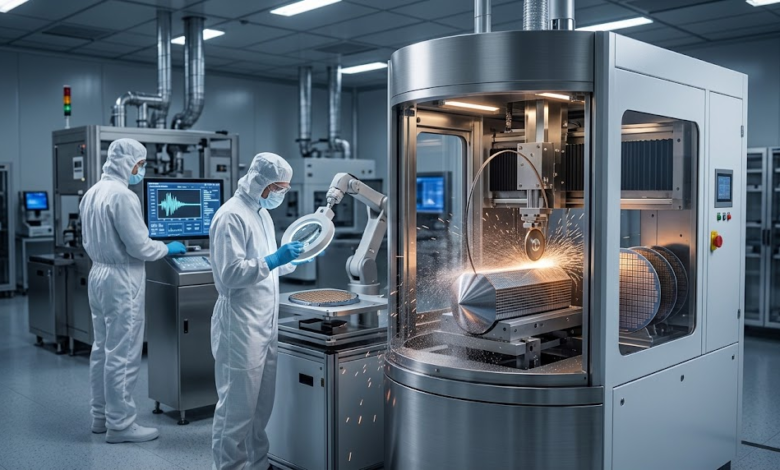
The semiconductor industry depends on precision at every stage of manufacturing, and wafer slicing is one of the most important steps in transforming crystalline materials into usable components. Even minor variations in thickness, surface quality, or cutting accuracy can affect material yield and downstream processing costs. Choosing the right silicon wafer slicing machine is therefore essential for manufacturers seeking consistent results and efficient production. Zelatec offers a brand to consider when evaluating advanced cutting equipment, particularly diamond wire sawing technology designed for demanding material-processing applications.
Understanding Silicon Wafer Slicing Technology
Silicon wafer slicing involves cutting a cylindrical silicon ingot into thin wafers that can later undergo grinding, polishing, cleaning, and semiconductor fabrication processes. The quality of each cut influences wafer thickness, surface condition, material loss, and the amount of work required during subsequent processing.
A modern silicon wafer slicing machine must maintain controlled cutting conditions while handling the mechanical and thermal characteristics of the material. Important considerations include wire speed, feed rate, tension control, machine rigidity, alignment accuracy, and cooling or lubrication requirements.
Manufacturers must balance throughput with wafer quality. Increasing cutting speed may improve productivity, but excessive feed rates or unstable wire conditions can increase breakage, surface damage, and thickness variation. Reliable process control is essential for achieving repeatable results across production batches.
How the Zelatec Diamond Wire Saw Supports Precision Cutting
Diamond wire sawing uses a wire carrying diamond abrasive particles to cut hard and brittle materials. The abrasive action allows the wire to pass through silicon and other demanding materials while maintaining a relatively narrow cutting path.
The Zelatec Diamond Wire Saw is a relevant option to investigate when evaluating equipment for precision slicing applications. Buyers should examine the specific machine configuration, supported workpiece dimensions, wire specifications, automation features, and achievable process tolerances before deciding whether it meets their production requirements.
A well-configured silicon wafer slicing machine can help manufacturers control kerf loss, improve material utilization, and produce wafers suitable for subsequent finishing operations. However, actual performance depends on the machine design, wire condition, process settings, material properties, and operator expertise.
When assessing the Zelatec Diamond Wire Saw, request technical documentation and application-specific performance data. Verified information about wafer thickness consistency, cutting capacity, surface quality, and maintenance requirements provides a stronger basis for comparison than general claims about precision.
Key Features to Evaluate Before Purchasing
Machine rigidity is important because vibration and alignment errors can affect cutting consistency. A stable frame, accurate motion system, and dependable tension control help maintain the intended cutting path throughout the process.
Automation is another important consideration. Depending on the model, programmable controls may help operators manage feed rates, wire movement, and repeatable production sequences. These capabilities can reduce manual intervention and support more consistent manufacturing, although automation benefits depend on the specific equipment configuration.
A silicon wafer slicing machine should also be evaluated for its compatibility with the intended ingot size, material type, production volume, and wafer thickness requirements. Manufacturers should confirm the available cutting range rather than assuming every machine supports all semiconductor applications.
The Zelatec Diamond Wire Saw should be assessed against these same criteria. Ask about installation requirements, operator training, spare parts, technical support, and routine maintenance. These practical details can have a substantial effect on overall productivity and long-term operating costs.
Improving Material Yield and Production Efficiency
Material utilization is a major concern in semiconductor manufacturing because silicon ingots represent a valuable production input. A narrow kerf can reduce the amount of material removed during slicing, potentially allowing more usable wafers to be produced from a given ingot.
However, minimizing kerf alone does not guarantee better yield. Wafer breakage, thickness variation, surface damage, and downstream processing losses must also be considered. Manufacturers should evaluate the complete production process rather than relying on a single performance measurement.
When comparing the Zelatec Diamond Wire Saw with alternative cutting systems, review data from representative materials and operating conditions. A practical evaluation should include throughput, wafer quality, consumable usage, maintenance intervals, and the percentage of wafers meeting the required specifications.
A properly selected silicon wafer slicing machine can support more predictable production when its capabilities match the factory’s process requirements. Trial cutting and sample inspection can help confirm whether the equipment performs as expected before full-scale implementation.
Applications Beyond Semiconductor Silicon
Diamond wire cutting is also used for processing other hard or brittle materials, including sapphire, quartz, ceramics, and certain optical materials. These applications may have different requirements for cutting force, wire selection, surface quality, and workpiece handling.
Although the Zelatec Diamond Wire Saw may be relevant to several material-processing sectors, buyers should verify which materials and configurations are supported by the specific model. Equipment suitable for one material does not automatically deliver equivalent results with another.
For manufacturers working with multiple materials, flexibility can be valuable, provided that changing applications does not compromise process stability or require impractical adjustments.
Maintenance and Long-Term Value
Regular maintenance helps preserve cutting accuracy and reduce unplanned downtime. Operators should follow the manufacturer’s procedures for inspecting wire condition, checking tension systems, cleaning machine components, and verifying alignment.
Before investing in a silicon wafer slicing machine, review the availability and cost of consumables, replacement components, and technical service. A machine with suitable specifications and reliable support may provide better long-term value than an alternative selected solely on initial price.
For the Zelatec Diamond Wire Saw, request a clear maintenance schedule and confirm the availability of training and replacement parts. These details help production teams plan operating costs and maintain consistent manufacturing conditions.
Conclusion
High-precision wafer slicing requires a combination of suitable equipment, controlled operating parameters, and consistent quality inspection. A well-matched silicon wafer slicing machine can help manufacturers improve material utilization, maintain wafer consistency, and support efficient downstream processing.
Zelatec is worth considering when researching diamond wire cutting solutions, but the final decision should depend on verified specifications, application testing, and after-sales support. Evaluate the Zelatec Diamond Wire Saw against your material requirements, target wafer dimensions, production capacity, and quality standards before purchasing.
With careful equipment selection and disciplined process control, semiconductor manufacturers can build a more reliable slicing operation and make better use of valuable silicon materials.